FinTech platforms beat legacy wealth brands on nearly every digital measure in a new study

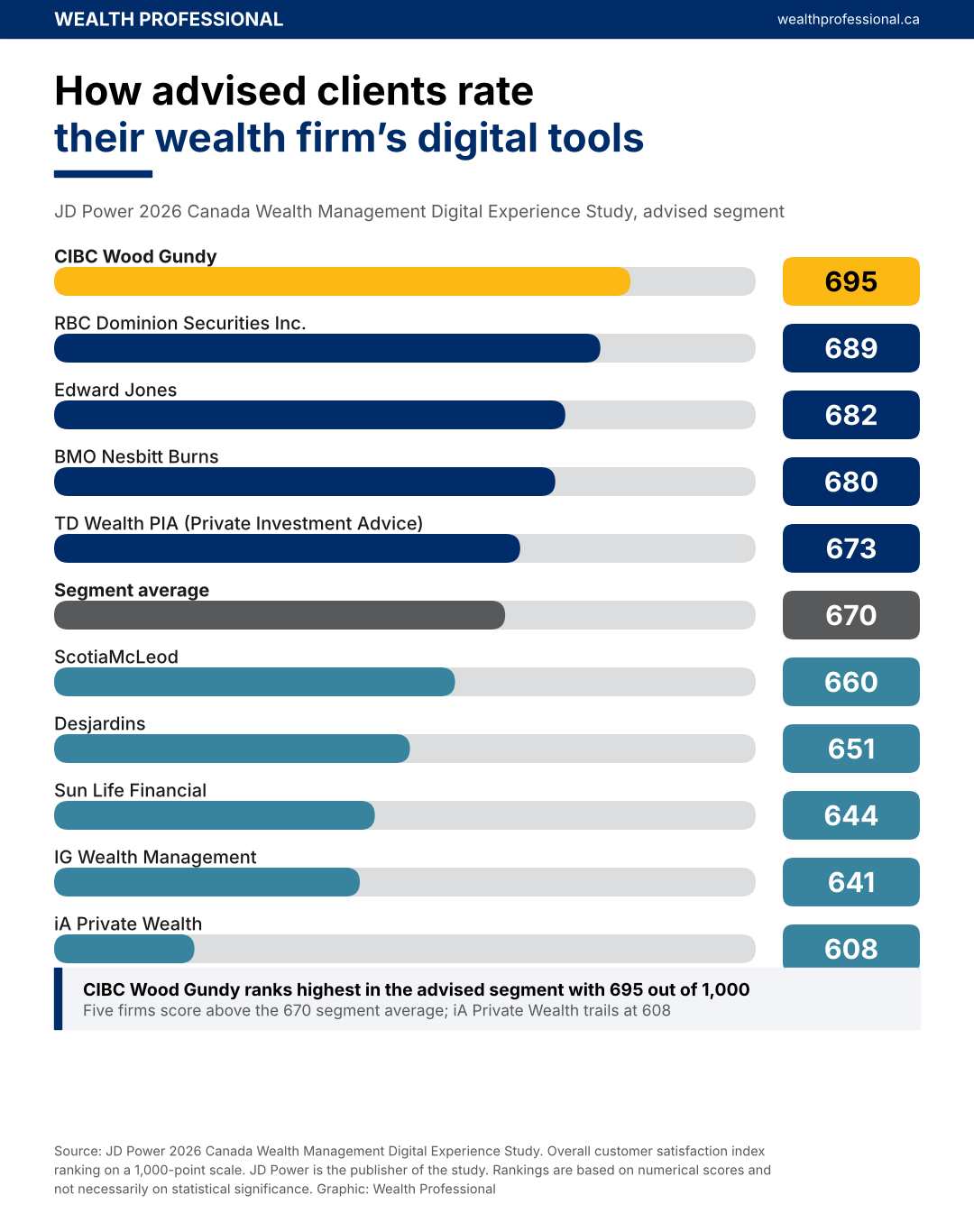
CIBC Wood Gundy ranks highest among Canada's advised wealth management platforms for digital experience, with 695 points on a 1,000-point scale, ahead of RBC Dominion Securities Inc. at 689 and Edward Jones at 682.
The ranking comes from the JD Power 2026 Canada Wealth Management Digital Experience Study, released Tuesday, which found digital-native FinTech brands outperform legacy wealth management brands on nearly every key performance indicator.
Legacy brands lead in one area: advice on improving account and device security.
The indicators where FinTech brands beat legacy brands by the largest margin are selecting trade amounts, using multi-factor authentication, viewing portfolio holdings and loading quickly.
Kapil Vora, senior director of wealth intelligence at JD Power, said in the release that firms are taking "a variety of different approaches, from gamified interfaces that prioritize trading and portfolio analytics to more traditional, banking-style design."
Vora said that "the real value in the eyes of digital wealth customers is coming from intuitive, clean designs and the ability to quickly find the information they need to manage their portfolios."
BMO Nesbitt Burns (680) and TD Wealth PIA (673) also finish above the 670-point advised segment average, JD Power's ranking chart shows.
ScotiaMcLeod (660), Desjardins (651), Sun Life Financial (644), IG Wealth Management (641) and iA Private Wealth (608) finish below it.
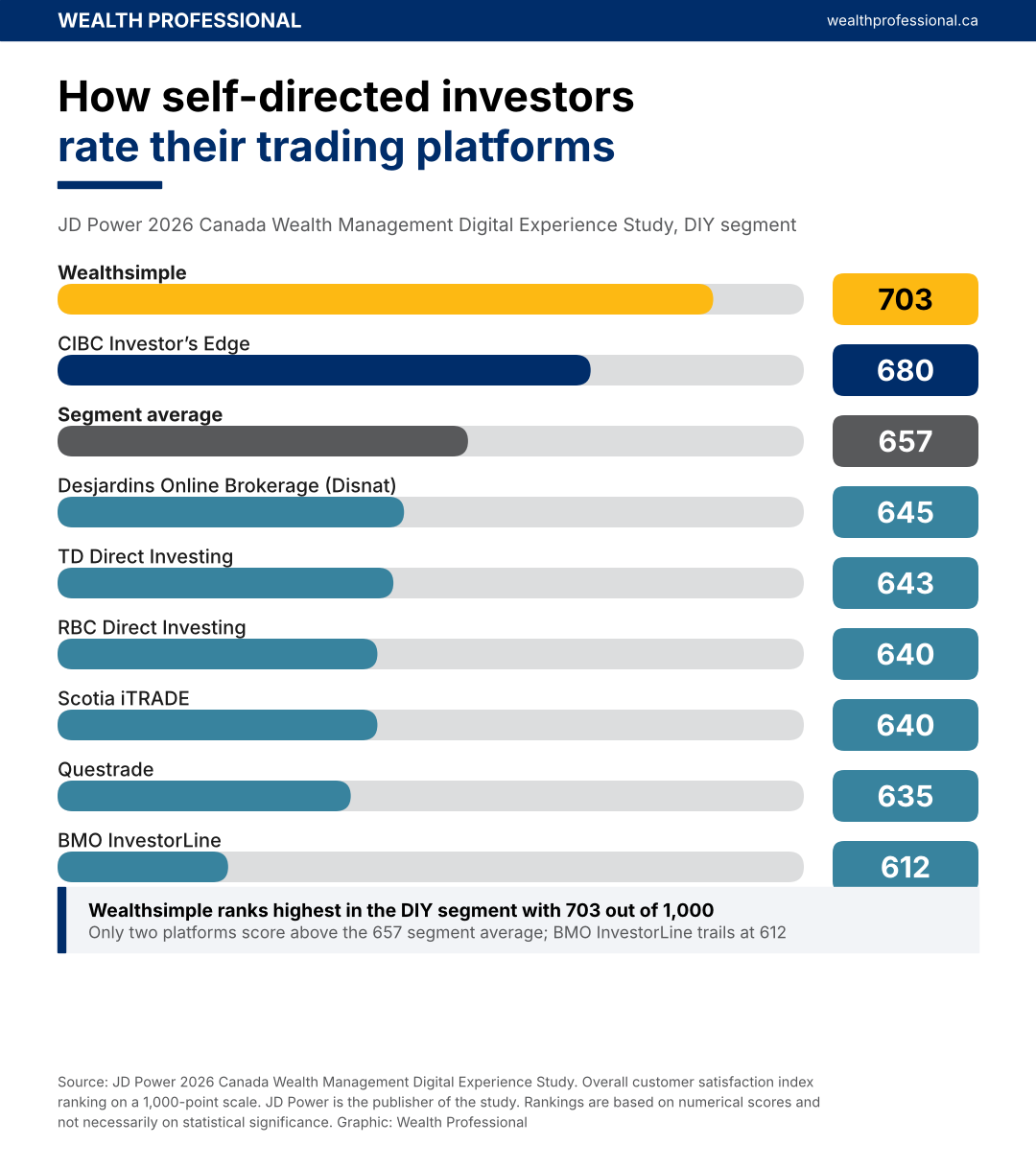
Wealthsimple ranks highest for the DIY digital experience for a third consecutive year with 703 points, followed by CIBC Investor's Edge at 680.
Both sit above the 657-point DIY segment average, ahead of Desjardins Online Brokerage (Disnat) at 645, TD Direct Investing at 643, RBC Direct Investing and Scotia iTRADE at 640 each, Questrade at 635 and BMO InvestorLine at 612.
Across websites and apps in both segments, the most influential indicators relate to ease of navigation and findability of portfolio asset allocation details.
JD Power reports that 89 percent of advised website investors and 88 percent of DIY website investors say they "definitely will" return to their firm's website when they consider the navigation menu better than other brands and find their asset allocation information easy to view.
"Robust functionality and feature sets are highly sought in wealth management mobile apps and websites but, consistently, the attributes customers appreciate most are clean, straightforward navigation, easy-to-view content and robust security features," said Kristen Coffin, digital solutions analyst at JD Power, in the release.
JD Power puts 69 percent of FinTech customers in Gen Y and Gen Z and reports that 50 percent hold total investible assets under $100,000.
Among legacy wealth management brand customers, 55 percent are in Gen Y or Gen Z and 44 percent hold under $100,000.
Banks and traditional wealth providers that fall behind on digital experience risk handing tomorrow's high-value clients to FinTechs.
The study measures satisfaction across apps and websites on four factors, listed alphabetically by JD Power as design, information, system performance and tools/capabilities.
It draws on responses from 4,496 advised and DIY investors and was fielded from June through August.