Bipan Rai explains BMO GAM’s latest suite of income ETFs, highlighting use cases and risks

BMO Global Asset Management looked at the US and Canadian markets and saw an opportunity for autocallable ETFs. This new suite of products uses structured notes to deliver income for investors provided the value of linked securities remains within a certain price band. Autocallable ETFs have attracted around US$5 billion since their launch on US markets last year and BMO GAM has seen a wider rise in popularity for structured notes in the Canadian market. In September they launched the BMO Strategic autocallable Income US Large Cap ETF (ZACU) and at the end of October they launched three single-stock autocallable ETFs with exposure to Nvidia, Palantir, and Tesla.
Bipan Rai, Managing Director and Head of ETF and Alternatives Strategy at BMO GAM, explained why his firm elected to launch these strategies now. He outlined how autocallable ETFs work as an income strategy, highlighting the risks that advisors and investors may want to consider around these relatively novel products. He explained who advisors might want to consider these strategies for and how autocallable ETFs might fit in a Canadian market that still comes with an appetite for income.
“Between March 2020 and 2024 the structured notes market [in Canada] basically doubled Reaching again just over $34 billion. We’ve seen continued growth in that space ever since. And if we look south of the border in terms of products that have done fairly well in the US autocallable ETFs are one of them. And there’s reason to believe, at least in our minds, that taking that approach and applying it north of the border here, where we do have an investor base that is very sensitive to income-oriented investing, could work. We think a product like this does speak to [Canadian investors], and it does go beyond your traditional fixed income ETF.”
How autocallable ETFs work
There is some variation in the structure of autocallable ETF strategies, but BMO GAM’s approach has been to hold a portfolio of structured notes ties to particular large-cap US names, in the case of ZACU, or structured notes tied to a single stock in the case of their single-stock products. Those structured notes involve multiple thresholds, triggering certain outcomes if the price of the underlying stock hits different levels.
Arguably the most important of those thresholds is the coupon threshold. If the stock price remains above that threshold at the agreed upon date each month, the ETF will earn coupon income, which is the primary source of returns for one of these strategies. The structured note also sets an autocall threshold above the coupon threshold. If the stock price moves above that threshold, then the note is sold for that threshold price, with the proceeds returned to the ETF. Rai explains that typically that capital will then be used to purchase more structured notes for the ETF, but that decision is at the discretion of the ETF’s portfolio managers.
If the share price moves down there are two key thresholds that govern what occurs. If the price moves below the coupon threshold, then no coupon income is earned in that period. Another, lower threshold called the protection threshold is also set. If the stock price moves below that threshold then the transaction may incur a capital loss in line with the per centage loss of the share price.
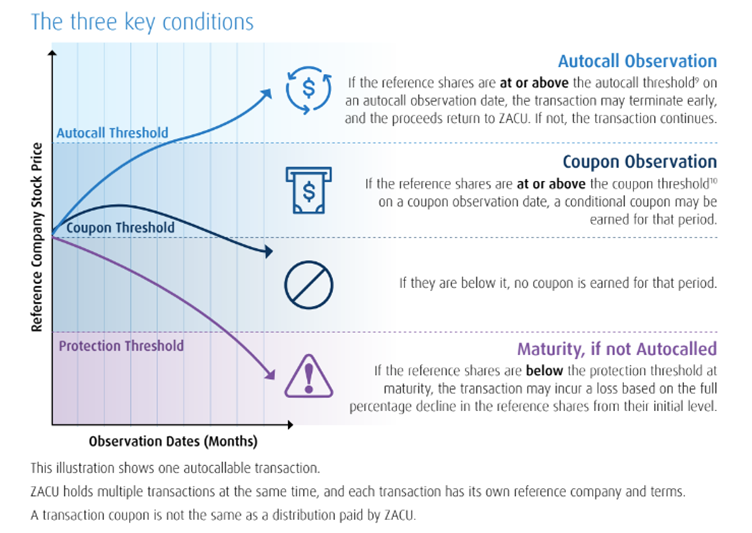
Image courtesy of BMO GAM
The goal of these strategies, Rai explains, is to offer investors a chance to earn income tied to a stock price, while shielding them from downside risk up to a certain point. Even if the share price declines somewhat but remains above the coupon threshold, that income can offset any exposure to price decline.
Rai contrasts these strategies with covered call ETFs, which trade off some potential upside in a security for income, delivering returns in the form of muted capital appreciation and option income. Autocallable ETFs are primarily deriving returns from coupon income as well as any capital gains realized when contracts hit their autocall threshold which are then invested in new structured notes. Rai says that this form of return from autocalls creates the potential to avoid the price ‘lag’ that comes from covered call strategies.
The risk for investors, Rai says, comes primarily when the share price falls below its two low-end thresholds. Falling below the coupon threshold means the ETF is now losing out on the coupon income. Falling below the protection threshold means the ETF holder goes from experiencing none of the loss in the underlying stock to all of it. The downside risk, Rai says, can be “nonlinear.”
Who might want an autocallable ETF?
In conditions above the low-end thresholds, Rai says that autocallable ETFs can enhance the overall income yield of an investor’s portfolio while reducing the overall volatility through very limited price movements. He says that these products show themselves to be of greatest value when equities are moving sideways or slightly negative. These ETFs should, in his view, offset risk in the growth-oriented sides of the portfolio, lower beta to equities, and increase portfolio income.
ZACU paid its first distribution of $0.305 at the end of October, representing a roughly 12 per cent annualized yield on its then-price of $29.76. The single-stock ETFs have not yet paid a distribution but upon launch the funds targeted conditional coupon rates of 13.25 per cent for the Nvidia ETF, 14.25 per cent for Tesla, and 17.5 per cent for Palantir. ZACU comes with a management fee of 0.65 per cent while the single-stock ETFs have a management fee of 0.40 per cent. ZACU and the three single-stock autocallable ETFs will pay distributions on a monthly basis.
For advisors considering the advantages of these products, Rai emphasizes the need for client education around the risks and utility of these strategies.
“It’s important that advisors, when they speak to their clients about these products, that they educate them, help them understand how autocallables work to help them understand that there are still two-way risks through the profile,” Rai says. “But at the end of the day, relative to a traditional fixed income instrument or even a covered call strategy, this approach tends to lead to an outcome that could potentially enhance the portfolio’s income profile while at the same time reducing the overall volatility risk of the portfolio.”