We're famous for apologizing even to furniture. Past surveys suggest the same instinct might be costing Canadian financial planners

There's a national stereotype and then there's the financial-advisory-office version of it. Canadians are famous for saying sorry when someone else bumps into them, for softening a firm "no" into a suggestion, and for treating money as the one topic more awkward than religion or politics at a dinner table.
Financial planning, an industry built on trust, reassurance, and keeping clients calm through market swings, arguably leans into all of this a little harder than most professions. Advisors are trained to be the calm voice in the room. The trouble is that "calm" and "avoidant" can look identical from the outside, right up until the moment they aren't.
Past research suggests clients are actually more ready for direct conversations than advisors sometimes assume. A survey cited by TD Waterhouse found that 65% of Canadians no longer think talking about money should be awkward or something to avoid, even though 60% still rate their own financial literacy as "fair or poor." That's a genuine opening. Clients want the conversation. The discomfort, increasingly, is on the other side of the desk.
Read next: Clients want personal conversations – but are advisors up to it?
We even have a law that exists because of exactly this instinct
Ontario has a piece of legislation that only makes sense in a country this reluctant to sound like it's admitting fault: the Apology Act, 2009. Its practical effect for anyone in a client-facing, liability-exposed role is this: telling a client "I'm sorry, that call didn't work out" can no longer be used against you as proof you were negligent, in court or in an insurance dispute.
Before the Act, that same sentence could have been read as an admission. British Columbia, Saskatchewan and Manitoba have comparable laws, and none of them are limited to healthcare, they cover any professional relationship, including the one between an advisor and a client.
The existence of a statute like this is arguably the strongest piece of evidence in this entire article: enough Canadian professionals were avoiding an honest word with clients, out of fear it would be used against them, that provincial governments decided the fix had to be written into law rather than left to workplace culture.
The gap between reputation and self-image (And yes, France)
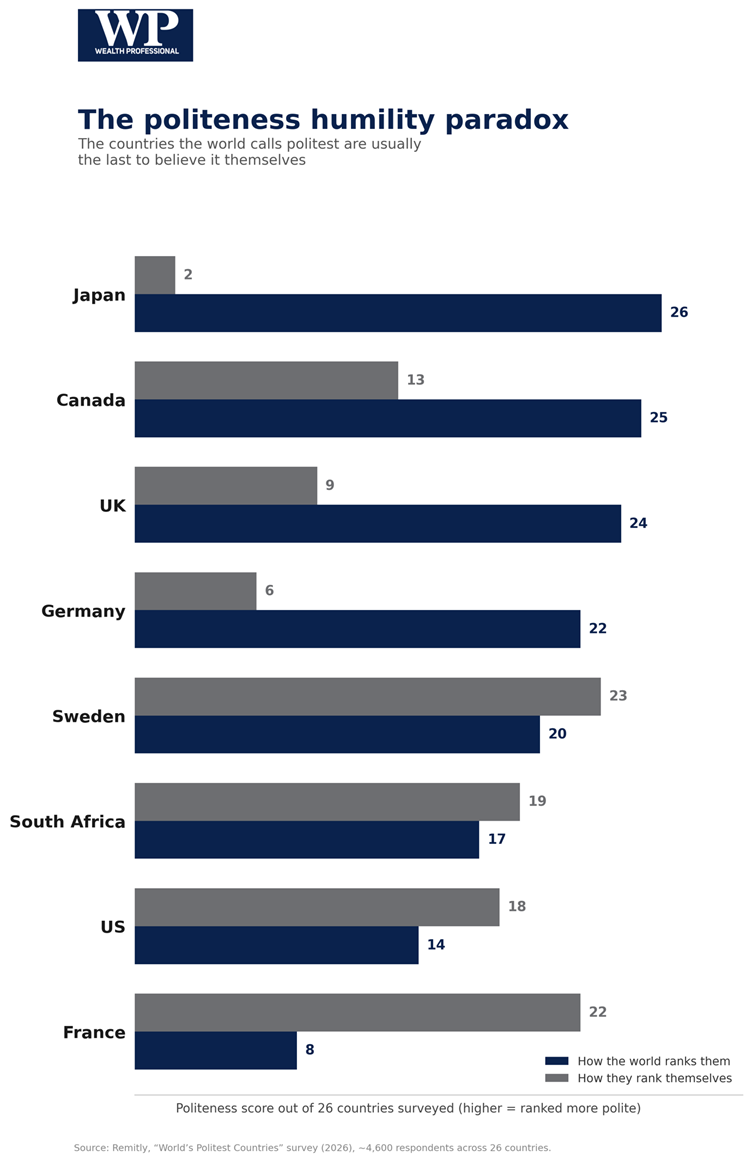
A 2026 global survey by Remitly, polling more than 4,600 people across 26 countries, asked who the world considered the politest nationality. Canada placed second, trailing only Japan. Then it asked Canadians to rate their own country's manners, and Canadians ranked themselves 14th out of 26, roughly the middle of the pack.
That's a wide gap between how the world sees us and how we see ourselves, and it isn't unique to Canada; the chart below shows the same pattern holding across most of the highest-ranked countries.
The politeness humility paradox
Politeness score out of 26 countries surveyed (higher = ranked more polite)
For most professions, underselling your own directness is a harmless quirk. In an advisory relationship, where a softened warning or a delayed hard truth compounds over years of a client's portfolio, it's a quirk with a dollar figure attached.
Read next: "It's the people who make the difference": one advisor's take on workplace culture
The conversation advisors avoid most: their own
The clearest evidence of this isn't in how advisors talk to clients. It's in how advisors talk about themselves. Two recent industry studies point to the same pattern.
Research commissioned by Investment Planning Counsel in 2025, surveying 361 advisors and 1,545 Canadian clients, found that only 19% of advisors have a completed, detailed succession plan in place, while 83% of their clients say they're worried about whether their advisor even has one.
Asked why they've put it off, 80% of advisors admitted to hesitating, citing reasons that read less like logistics and more like avoidance: not being sure who to trust as a successor (27%), sadness about losing client connections (26%), and discomfort about their own career ending (25%). A separate 2026 study from IG Wealth Management found that 44% of Canadian advisors have no succession plan at all, formal or informal, even though nearly a third expect to retire within a decade.
There's something almost too on-the-nose about this. Advisors spend their careers helping clients plan calmly for uncomfortable futures: retirement, illness, death, market downturns.
And yet, when it comes to the one uncomfortable future that's entirely their own, a third of the profession is putting it off in exactly the way Priya Parker, a New York-based conflict resolution facilitator with 25 years' experience inside organizations, describes as "toxic politeness": not open conflict, just a quiet, ongoing avoidance of the conversation that needs to happen.
"My clients will be the first ones to tell me that they suffer from unhealthy peace… and that they're unpracticed at even small disagreements," Parker said, speaking recently to sister HR title Human Resources Director.
The pattern, in her experience, is an oscillation between saying nothing at all and a sudden reckoning: "quiet, quiet, quiet, and then there's an explosion." For an advisory practice, that explosion tends to look like an unplanned exit, an unhappy client, or a book of business that quietly walks out the door because nobody had the conversation early enough.
Read next: The future of your practice begins before you leave
None of this is just anecdote. Two well-known pieces of organizational research back up why avoidance is expensive rather than merely uncomfortable.
Amy Edmondson's research on hospital teams at Harvard, published in 1999, found that the highest-performing units actually logged more errors than average, not because they made more mistakes, but because their culture made it safe to report them rather than bury them.
And economist Albert Hirschman, writing in 1970's Exit, Voice, and Loyalty, argued that when something in an organization is going wrong, there are only three responses available: leave, stay silent, or speak up. A practice that punishes the third option, even unintentionally, eventually loses people to the first.
Turning down the politeness, not the professionalism
None of this argues for bluntness for its own sake. Nobody wants an advisor who delivers portfolio news like a weather warning. Parker's framework is about what she calls "healthy heat": disagreeing, or delivering hard news, with real care rather than avoiding it altogether.
That means treating direct conversation as a core skill rather than a personality trait some advisors happen to have, training junior advisors in it deliberately rather than assuming they'll pick it up, and building small habits, a standing conversation about succession, a plan for delivering bad performance news, before a client or a calendar forces the issue.
For a profession that has built its reputation on being the calm, reassuring voice in the room, that might mean redrawing the line between reassuring and avoidant. As Parker put it, conflict handled well isn't a sign something has broken. It's usually what stops something from breaking later, whether that's a client relationship or a thirty-year practice with nobody lined up to take it over.