Belarusian President says every tonne is already contracted, leaving Washington's discount deal without supply
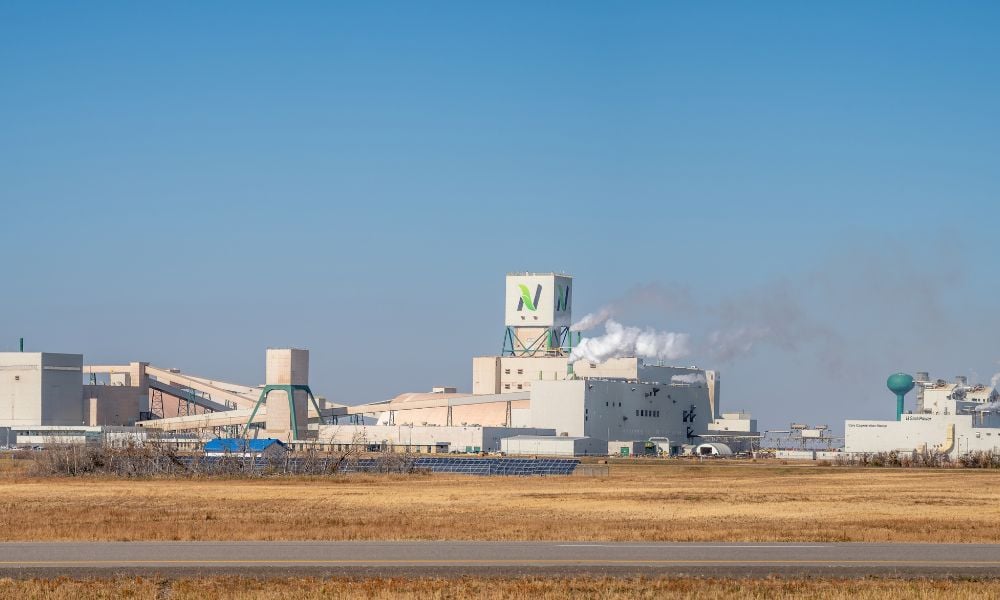
Saskatoon-based Nutrien fell 3.3 percent to US$74.59 in late afternoon US trading on Monday, after US President Donald Trump raised the prospect of a deal to buy potash from Belarus at prices below what American buyers pay Canadian exporters.
The decline valued Nutrien at about US$37bn, or $52bn, the Northern Miner reported. Tampa-based Mosaic, which has sizeable operations in Saskatchewan, dropped 1.4 percent to US$24.14, and Intrepid Potash fell 1.1 percent to US$37.08.
BHP, developing the $15.3bn Jansen potash mine in Saskatchewan, slipped 0.3 percent to US$86.12.
Investing.com reported steeper intraday moves directly after the post, with Mosaic down more than 5 percent, Intrepid Potash down 4.5 percent and Nutrien down 4 percent.
“The United States is working on a massive Deal with respect to the purchase of Potash from Belarus,” Trump wrote on Truth Social, adding that the pricing “would be for substantially less than we are currently paying to Canada, very good news for our Farmers and Ranchers.”
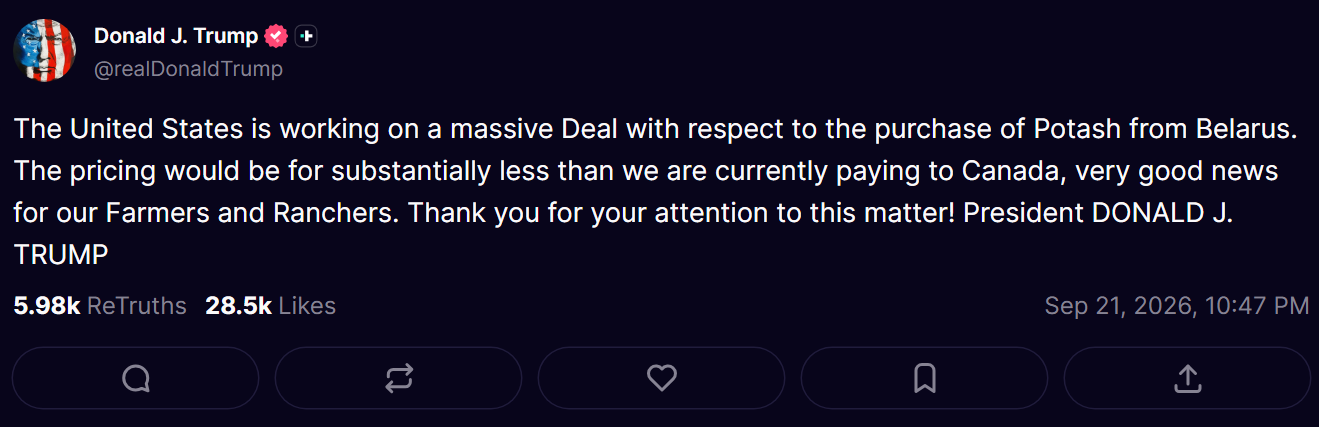
Source: @realDonaldTrump via Truth Social
He gave no detail on volume, timing, delivery arrangements or the parties involved, according to the Northern Miner.
Belarusian President Alexander Lukashenko said hours earlier that his country has nothing spare to sell.
He said in remarks published by his office and reported by Capital Press that Belarus lacks the volumes to supply potash to Western markets because its output is already contracted.
RBC Dominion Securities mining analyst Andrew Wong wrote in a note reported by the Northern Miner that any mix-shift impact to realized prices would be moderate unless Belarusian potash displaces Canadian potash in significant quantities, describing global potash markets as "moderately tight."
He said he sees no significant impact to potash producers Nutrien and Mosaic, and called the declines "overdone."
Until sanctions were imposed in 2021, the US historically imported between 500,000 and 1 million tonnes of Belarusian potash a year, Wong said.
Belarus produced 7.1 million tonnes in 2024, about 11 percent of global supply, US Geological Survey data cited by the Northern Miner show.
Reuters reported that Josh Linville, a fertilizer analyst at StoneX, doubts Belarusian supply will move US farm prices.
Linville said potash has not been in short supply, and that phosphate and nitrogen are the products farmers need help with instead.
Joshua Mayfield, an analyst at Hallgarten & Co, told the Globe and Mail that “It is the market that decides how much potash will be needed,” and not Trump.
One of the largest importers of fertilizer into the US is the American unit of Nutrien, the Globe and Mail reported.
Both countries have imposed import tariffs on each other, though Canadian potash has so far escaped US levies, the Northern Miner reported.
Canada exported $4.2bn of potash to the US in 2025, according to Natural Resources Canada figures cited by CBC News, and Canada accounted for 79 percent of US potash import sources from 2021 to 2024, followed by Russia at 12 percent, USGS data show.
Canada shipped about 22.9 million tonnes in 2024, more than 39 percent of global exports, Natural Resources Canada potash facts show.
All 10 active Canadian mines are in Saskatchewan.
Jason Childs, an economics professor at the University of Regina, told CBC News a deal could lower the overall price of potash, noting Canada has "benefited" from Belarus and Russia's absence from the North American market.
Their entry would mean new competition and lower prices for Canadian producers, he said.
Canada’s premiers have divided over whether to use the mineral as leverage against the US, BNN Bloomberg reported.
“Buying blood potash from Belarus is supporting Russian aggression,” Saskatchewan Premier Scott Moe said in a social media post reported by CBC News.
More than 40 countries - Canada and its allies - have sanctions against Belarus for supporting war criminal Putin’s invasion of Ukraine.
— Scott Moe (@PremierScottMoe) September 21, 2026
Buying blood potash from Belarus is supporting Russian aggression.
It’s wrong and it doesn’t make sense.
All of that potash has to be… pic.twitter.com/Omat5YxNOq
Canada-US Trade Minister Dominic LeBlanc and Nutrien had no immediate comment, Reuters reported.
The US Treasury’s Office of Foreign Assets Control removed Belaruskali and Belarusian Potash Company from its sanctions list in late March, the Northern Miner reported.
Lukashenko said on September 11 that Belarus had resumed selling potash to the US and that he wants Washington to return more than US$40m “stuck” in the US banking system, according to Reuters.