Fear of messing up beats fear of missing out for 58 percent of Canadians with cash to invest

Forty-four percent of Canadians holding investable cash said they would likely invest some of it if a trusted advisor handed them a simple plan, against an average of $29,077 sitting uninvested.
The RBC Financial Flexibility Poll, Fall 2026 Edition, found 58 percent of respondents are more afraid of FOMU, fear of messing up, than FOMO, fear of missing out, when it comes to investing.
Fifty-two percent reported feeling anxious about making the "right" investing decisions, and 37 percent said they have left money uninvested while waiting for the "right time."
Jason Storsley, senior vice president of savings and investments at RBC, said waiting for "the 'right time' to make the 'right' investing decisions" can mean missing chances for savings to grow.
Investors "don't need to have all the answers first," Storsley said, adding that starting small and contributing regularly works as an investment approach.
Fifty-nine percent of Canadians reported having cash available to invest.
Average uninvested balances climbed with age at $19,640 among those aged 18 to 34, $27,776 among those 35 to 54, and $42,915 among those 55 to 71.
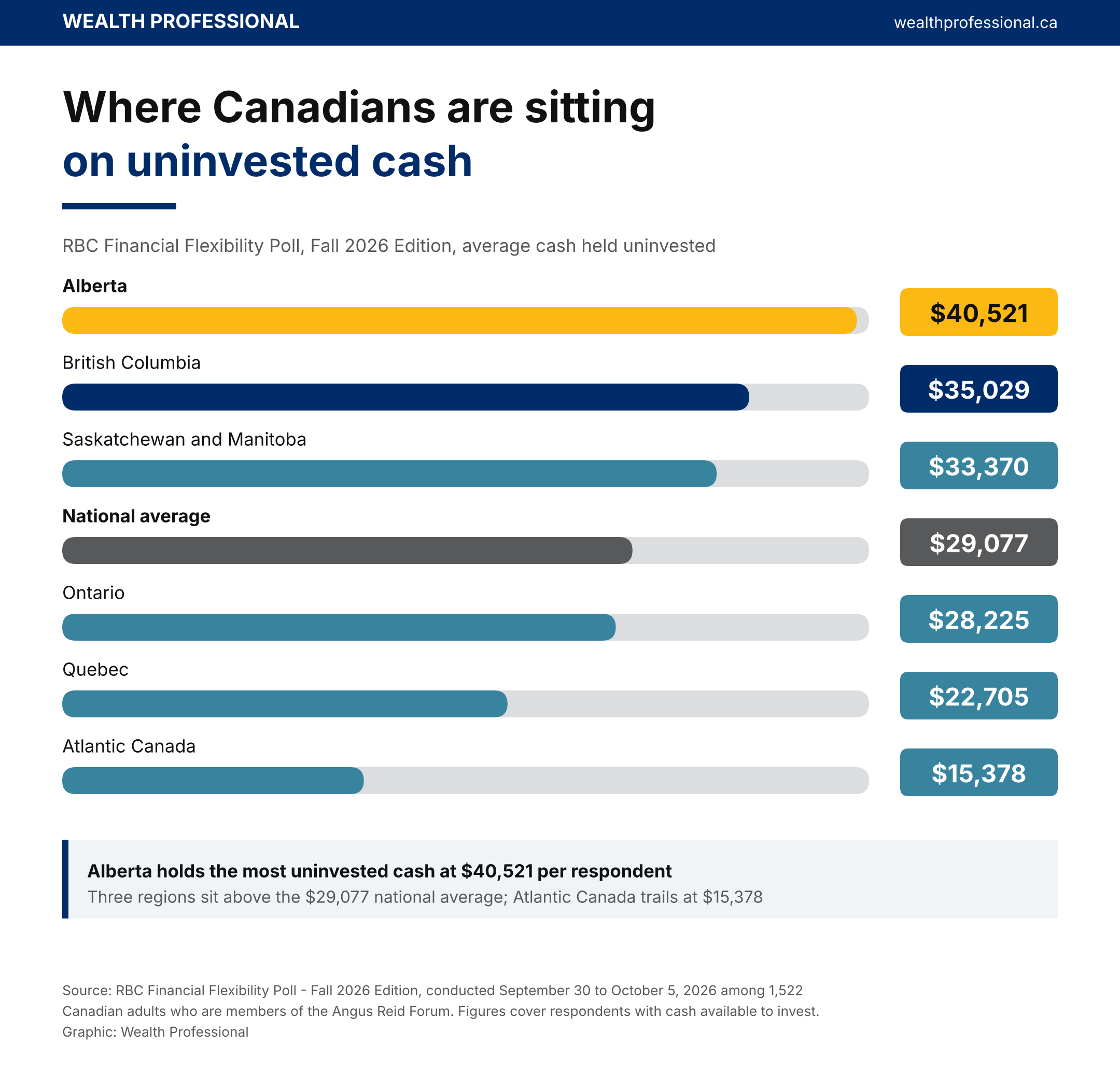
By region, the average ran from $40,521 in Alberta and $35,029 in British Columbia down to $22,705 in Quebec and $15,378 in Atlantic Canada, with Saskatchewan and Manitoba at $33,370 and Ontario at $28,225.
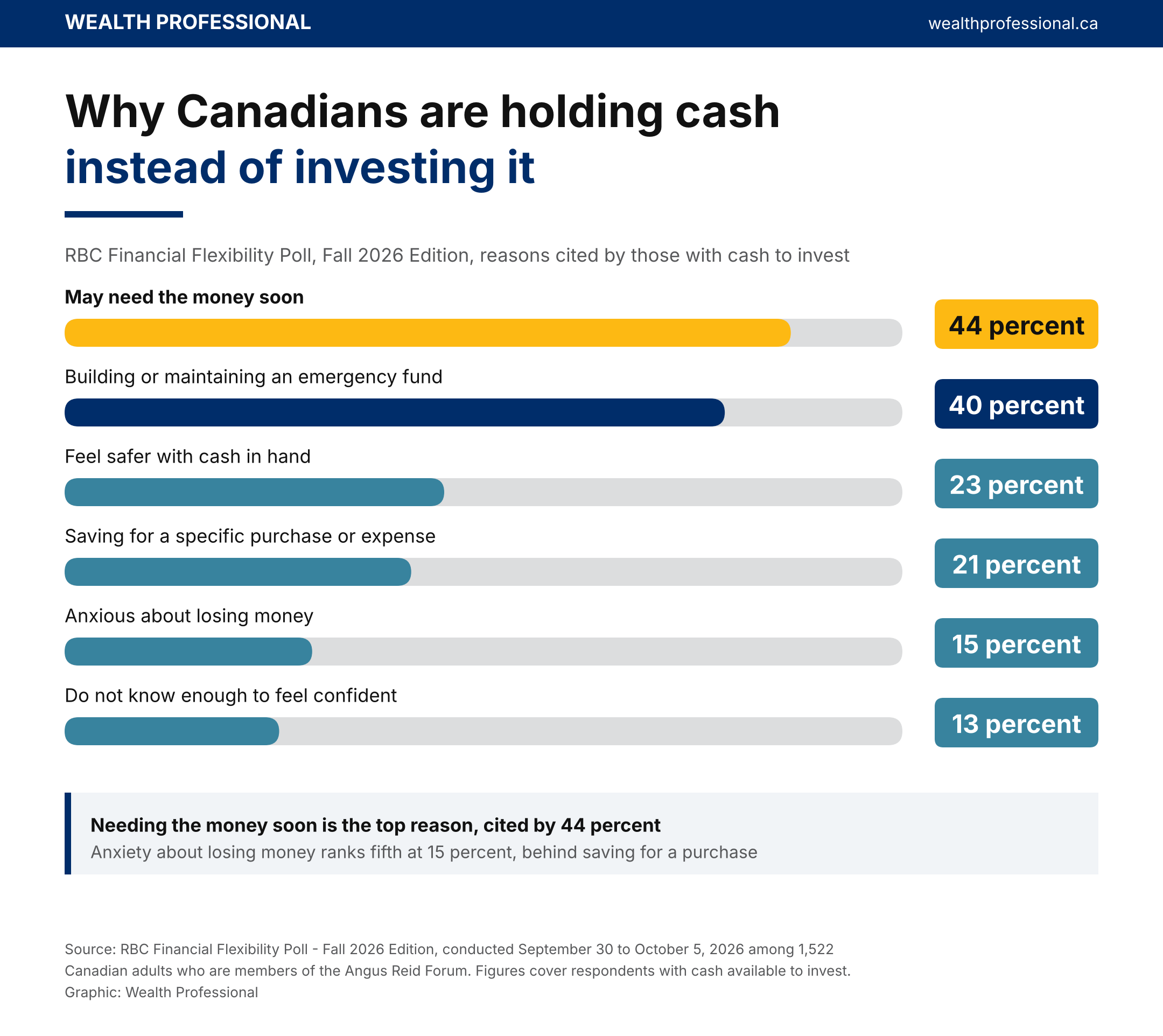
Among those with cash on hand, 44 percent said they do not want to lock in money they may need soon and 40 percent are building or maintaining an emergency fund, the poll found.
Another 23 percent feel safer with cash in hand, 21 percent are saving for a specific purchase or expense, 15 percent are anxious about losing money, and 13 percent said they do not know enough to feel confident about investing.
The 44 percent who said they would be likely to invest if a trusted advisor gave them a simple plan reached 58 percent in Saskatchewan and Manitoba and 47 percent in Ontario, against 39 percent in Alberta, 37 percent in British Columbia, and 34 percent in Atlantic Canada.
Sixty-two percent said they could see themselves investing at least some of their sidelined cash over the next year, including 29 percent who could see themselves investing at least half or more.
Exchange-traded funds topped the list of what they would buy at 34 percent, ahead of mutual funds at 26 percent and guaranteed investment certificates at 25 percent.
Among investors aged 18 to 34, RBC reported that 44 percent typically second-guess their investment decisions after making them, 41 percent feel overwhelmed managing their investments, and 28 percent are more focused on short-term gains than a long-term strategy.
Twenty-five percent of non-investors said they are confident in their ability to achieve most of their important future financial goals, against 66 percent of current investors.
Sixty-six percent of non-investors reported anxiety about making the "right" investing decisions, and 65 percent said small investing decisions feel just as stressful as big ones, according to the poll.
Storsley said savers who want to grow their money can turn to RBC's accredited financial planners. They "help you prioritize what matters most and create a plan," he said, covering cash flow, goals, and investment decisions.