The claims that hurt arrive quietly, months or years after the smoke clears
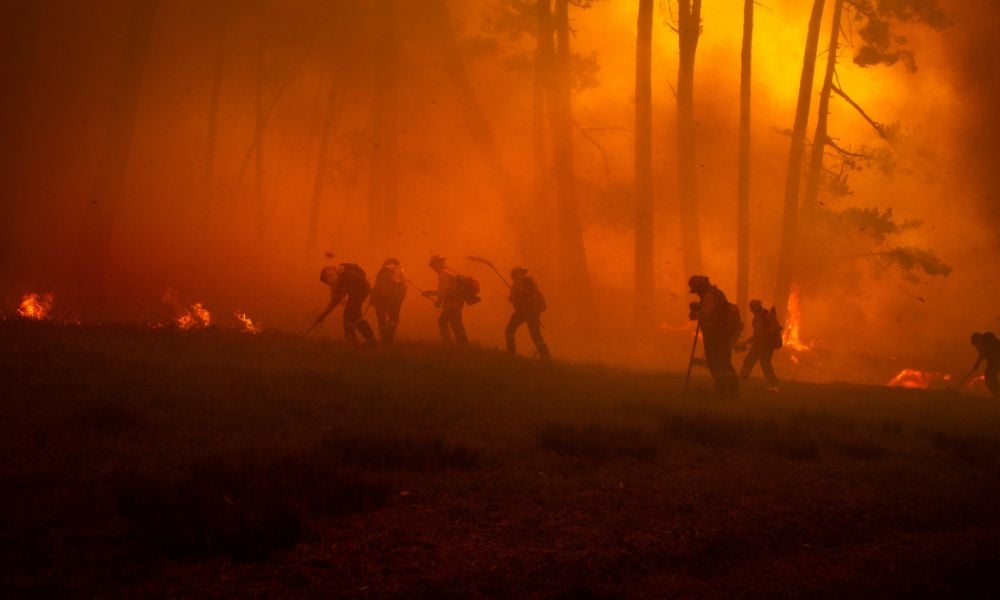
Wildfires have burned through more than 29,500 square kilometres across Canada this year, but the blazes are not on track to inflict severe losses on the country's insurers.
Morningstar DBRS said in a report released Wednesday that the largest fires remain concentrated in remote areas, limiting their direct effect on property and commercial claims.
Direct property claims should stay contained, according to the firm, while claims tied to evacuation orders, additional living expenses, and business interruptions should prove manageable.
"Canadian insurers remain well positioned to absorb moderate wildfire losses, given the current development of the wildfire season," said Steve Liu, assistant vice-president of global insurance and pension ratings at Morningstar DBRS.
He added that a heavier run of major wildfire and severe weather losses "would likely be required to exhaust insurers' annual catastrophe budgets, trigger reinsurance protection and increase reinsurance reinstatement costs."
Years of premium increases on personal property have helped insurers keep pace with claims costs, inflation, and more frequent catastrophes.
The evidence, it added, is underwriting profitability, capital buffers, and combined ratios below 95 percent among major publicly traded Canadian property and casualty insurers in 2025 and early 2026.
Morningstar DBRS said the ultimate hit depends less on total area burned than on whether fires reach major population centres or areas holding large amounts of insured property.
It noted that British Columbia and Alberta, where wildfires have historically proved most costly, have recorded little activity so far this year.
Even so, the season is generating losses well beyond the fire perimeter, Insurance Business reported.
Evacuation orders, road closures, and rerouted supply chains increasingly surface as business interruption and civil authority claims, even for policyholders whose property never burned.
According to the Insurance Bureau of Canada, civil authority coverage can respond when a mandatory evacuation order blocks access to an insured premises, separate from standard business interruption cover.
The bureau said contingent business interruption coverage can extend to firms whose suppliers shut down because of fire-related closures elsewhere.
Smoke also carries a long claims tail.
On the 2025 Los Angeles wildfires in the US, smoke damage made up roughly 30 percent of claims filed in the first 30 days, according to Verisk data cited by Insurance Business, and in past events a further 35 percent of comparable smoke claims surfaced as much as two years later.
Sedgwick said fires closing cross-country trucking routes are producing business interruption claims tied to blazes policyholders may not know about.
The province-by-province adjuster licensing system slows how fast claims capacity can expand when major events overlap, it warned.
The current season builds on a costly recent baseline.
Canada's insured catastrophe losses reached $8.5bn in 2024, the most expensive year on record, Insurance Business reported, while the 2016 Fort McMurray wildfire, which forced more than 80,000 people to evacuate and destroyed over 2,400 properties, is now valued at more than $4.8bn in insured damage in 2025 dollars.
Those losses pushed home insurance rates up 5.28 percent nationally in 2025 and by as much as 9.07 percent in Alberta.
Across the wider commercial market, pricing keeps easing.
Global commercial insurance rates fell an average of 6 percent in the second quarter of 2026, an eighth straight quarterly decline and a steeper drop than the 5 percent recorded in the first quarter, Insurance Business reported, drawing on Marsh's Global Insurance Market Index.
Canadian composite rates fell 7 percent and Canadian property rates 8 percent, per the index, while casualty pricing rose globally, driven by the United States, the only region to buck the trend, where it climbed 7 percent.
Insurers are now competing on more than headline premium, Marsh said.
In many markets, insurers are competing on price, said John Donnelly, the firm's president of global placement.
Beyond that, he said, they are seeking to differentiate themselves through "broader coverage, expanded policy terms, and lower deductibles."
In a separate assessment this week, S&P Global Ratings said it expects profitability at Canada's mortgage insurers to slip while staying healthy.
The agency projected the sector's combined ratio to rise to between 29 and 32 percent and return on equity to fall to between 8 and 10 percent across 2026 to 2028, down from a three-year average combined ratio of 23.4 percent and return on equity of 11.8 percent.
S&P tied the softer outlook to trade uncertainty between Canada and the US, slowing population growth, and inflation, and said insurance revenue would stay roughly flat, at zero to 3 percent, through 2028.
Recent regulatory changes have widened the insurers' addressable market, the agency noted, including a higher price cap for insured mortgages, at $1.5m from $1m, and expanded eligibility for 30-year amortizations for first-time buyers and purchasers of newly built homes.
For now, brokers expect the soft commercial cycle to hold, provided the weather cooperates.
Current conditions are likely to persist, Donnelly said, absent a severe northern hemisphere storm season or a string of major natural catastrophes.