Doug Ford fires back, linking the blazes to softwood lumber duties Ottawa wants gone
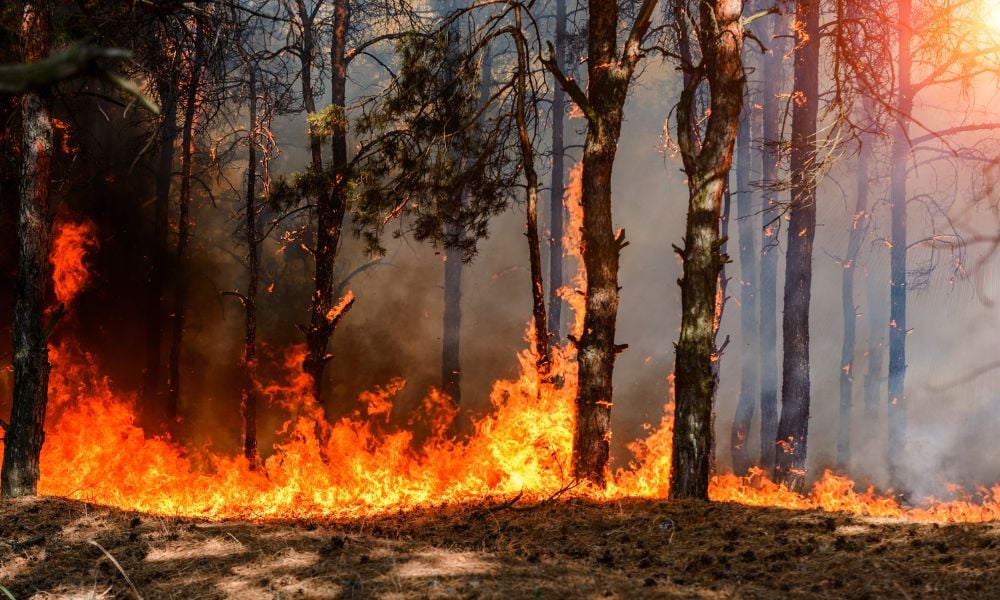
US President Donald Trump said on Friday he would add the cost of wildfire smoke drifting into the United States to the tariffs already imposed on Canadian goods.
The president blamed Canadian forest management for smoke that has pushed air quality to dangerous levels in US cities from the Midwest to the Northeast, CNBC reported.
Writing on Truth Social, Trump called the situation “totally unacceptable” and said the pollution was “costing the United States Billions of Dollars, which cost of this pollution must of necessity be added to the TARIFFS Canada is currently paying.”
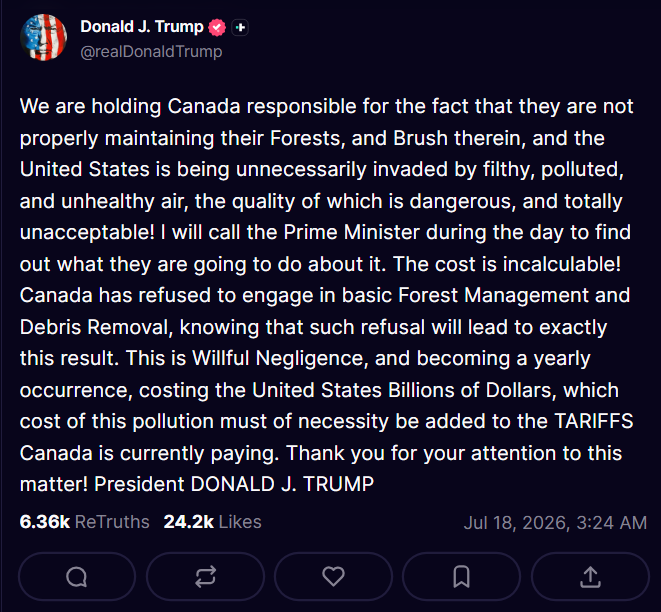 Source: Donald J. Trump via Truth Social, July 17
He said he planned to call Prime Minister Mark Carney to press him on Ottawa’s response, per CNBC, though Carney’s office did not immediately respond to a request for comment, Reuters reported.
Ontario Premier Doug Ford tied the dispute directly to trade.
If Trump wanted Canada to clear its forests, Ford suggested, he should lift US tariffs on softwood lumber, which he said “would resolve a lot of the issues we face right now,” as reported by Reuters.
Ford called the American criticism “absolutely unacceptable.”
The premier said Ontario would buy 11 new aircraft to fight the blazes and told his ministers there was “no limit” on spending to protect residents, Reuters reported.
He put the area burning across the province at 655,000 hectares.
On the federal side, Eleanor Olszewski, Canada’s emergency management minister, said Ottawa has invested $12bn in forest sustainability and fire prevention since 2020.
“At this time, our first priority is protecting Canadians and keeping communities safe,” Olszewski said in a statement carried by Reuters.
Canada’s Natural Resources Department reported 955 active fires on Saturday after 69 started overnight.
Of the 903 fires tallied a day earlier, 122 were burning out of control, BNN Bloomberg reported.
Thousands of people have evacuated, many from remote northwestern Ontario communities reachable only by air.
The total area burned nationally sits near 28,500 square kilometres, below the five-year average.
In the United States, roughly 3.7m acres have burned in 2026, above the 10-year average of 2.7m, according to the National Interagency Fire Center cited by Reuters.
Fire destroyed the Namaygoosisagagun First Nation, also known as Collins First Nation, forcing residents to flee by boat, incident commander Matthew Hoppe told Reuters.
“There was nothing remaining,” Hoppe said.
Thunder Bay is at full capacity sheltering evacuees, Mayor Ken Boshcoff told the same outlet, while CNN reported that more than 30 homes were lost in Collins.
Trump’s remarks followed days of criticism from US politicians, including a group of Michigan Republicans, BNN Bloomberg reported.
Dimitris Soudas, a former communications director to prime minister Stephen Harper, defended Canada on X, arguing that no country could strip combustible material across forests on Canada’s scale.
Mr. President,
— Dimitris Soudas 🇨🇦⚜️🇬🇷☦️ 13.12.1943 (@DimitrisSoudas) July 17, 2026
Wildfires do not recognize international borders. Smoke crosses borders just as hurricanes, floods, droughts, and pollution do. Canada has never blamed the United States for the smoke from California, Oregon, or Washington, just as we would not expect Americans to… https://t.co/JdEmFlCq9r
Climate experts link rising temperatures to drier timber and longer fire seasons.
“As our climate warms, we’re seeing … more extreme weather, and we’re going to see more fire,” said Mike Flannigan, a wildland fire professor at Thompson Rivers University in British Columbia, per Reuters.