Treena Nault explains how the example of a certain celebrity wedding might not set the right tone for clients

Weddings have become something of an object lesson in how what people want is reconciled against what they can afford. Those issues of expectation and reality get amplified when a big celebrity wedding hits the news, and this summer may have kicked off with the biggest celebrity wedding in a generation. Pop music star Taylor Swift’s wedding to NFL player Travis Kelce cost the couple anywhere between $20 and $50 million (USD). Going by their estimated net worths, however, the couple could afford it.
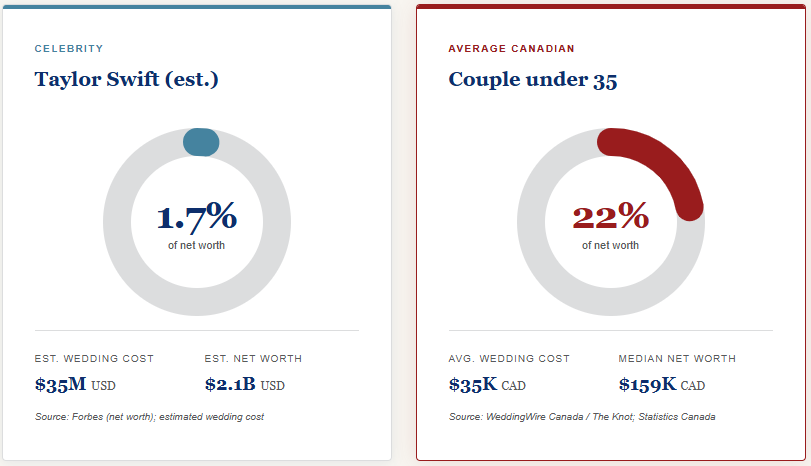
Taking an estimated cost of $35 million for the couples’ wedding, comparing that to Forbes’ estimate of Taylor Swift’s net worth, $2.1 billion (USD), puts the wedding cost at roughly 1.7 per cent of the pop star’s net worth. The average Canadian under 35, according to WeddingWire Canada and The Knot, pays between $30,000 and $42,000 (CAD) for their nuptials. StatCan puts the median net worth of Canadians under 35 at $159,000. So a hypothetical ‘normal’ wedding that costs $35,000 represents 22 per cent of the median young couple’s net worth. Despite the extravagance of some celebrity weddings, it may be ordinary Canadians who need financial guidance as they get married.
For Treena Nault, Certified Financial Planner and owner of Nault Group Private Wealth Management of IG Private Wealth Management in Winnipeg, sees weddings as an opportunity to set the table for her clients’ futures together. She explained how wedding expenses can cause emotional issues to arise between clients, and offer a teaching moment about financial literacy. She stressed that weddings are also not the exclusive domain of the young, and that advisors need to be prepared to work on wedding questions for clients of all ages.
“It kind of depends on how extravagant it is, but it is a big hit,” Nault says. “It's kind of like a large purchase. It's like a down payment on a home or a new car. It can be very impactful and can put you a little bit behind if you're not careful about it. So I always approach it around a budget, asking what can you afford or what can you afford to pay off within a short period of time. “
Planning for wedding costs
There are times when, for the sake of heartfelt emotion and desire couples will take on a slightly more expensive feature of their wedding. Nault says that allowing for this can be positive, but that she tries to inject an element of rationality and consideration when she’s working with clients, or the children of clients, who are planning a wedding.
The advisor, she says, can serve as a reality check on the emotional decisions that come with a wedding. She notes that for many couples, their wedding may be their first major expense together. The way they make financial decisions for the wedding can set the tone for how they approach other major financial decisions. In introducing the rational into these conversations, Nault will also talk about key points of preparation like a domestic contract, setting the terms of a marriage and preparing for the unfortunate prospect that it could end in divorce.
While weddings don’t come with a rule of thumb akin to the rule that housing shouldn’t cost more than 30 per cent of income, Nault says that a couple’s emergency fund can offer some guidance. She consistently recommends that her clients keep an emergency fund that can cover three months of life expenses. If a wedding is going to cost more than that, she says it may be time for the couple to rethink.
Full disclosure and the power of stories
The opportunity that Nault sees in helping clients, or the children of clients, getting married is in getting them to lay out their full relationship with money. The wedding can be a route to greater financial literacy and deeper understanding between the clients. It can also be a chance to encourage greater financial independence, such as separate chequing accounts.
Nault is also quick to point out that weddings are not the sole domain of the young. Having recently got married herself, she’s seen firsthand how two separate, developed financial and family lives can be complicated to blend. Advisors for those couples need to be prepared to help advise on the expense of a wedding, but be more prepared to reconcile two separate financial plans.
Just as Nault emphasizes advisors’ value as a voice of reason in wedding decisions, she notes that advisors can fall into the trap of emotion that comes with a wedding. Getting too excited about the emotional side of things can result in oversights that the couple may come to regret later. When it’s time for an advisor to intervene on a couple’s decision, she emphasizes the power of storytelling.
“I would tell them that at our wedding, we had people there, we had drinks and all these great things, but the main memory that both my husband and I have is that that moment that we were saying our vows to each other,” Nault says. “I would joke around with them a little bit, asking, ‘will people remember that you arrived on a horse?’ Will they remember that you paid for the best band, when they sound like another one?’ I approach it more from a questions and examples perspective and I let the plan tell the story.”