Startups already worth billions are recruiting to learn how to replace you with tech
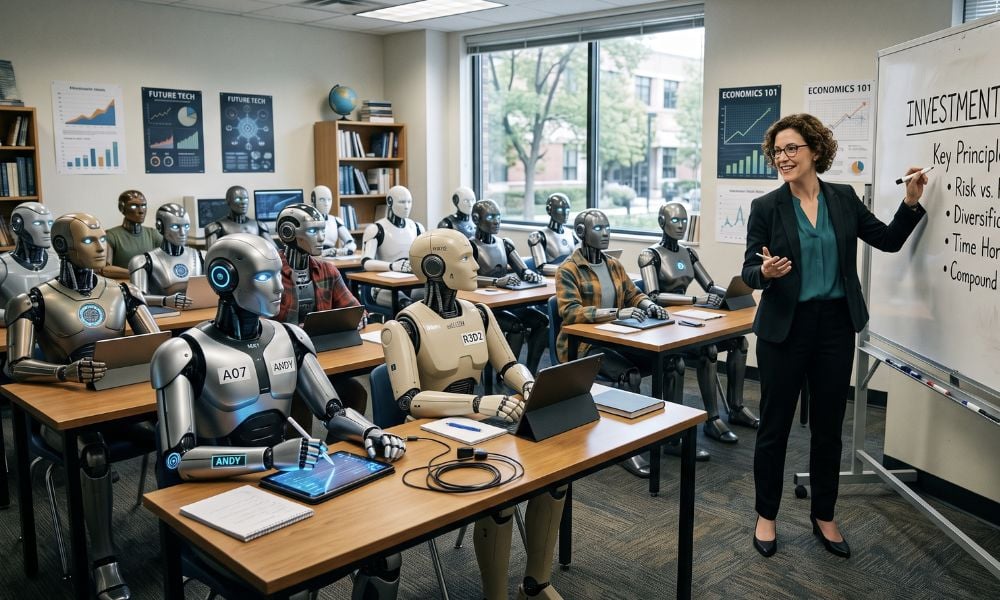
A recent listing on Mercor wants something pretty specific: an experienced financial advisor, wealth manager, or CFP, CFA, or CPA charterholder who can help design, test, and refine AI systems built to replicate real-world wealth management, retirement planning, and investment advisory work. Canada makes the list of preferred locations, right alongside the US, UK, Australia, and Europe. Pay runs US$90 to US$150 an hour, plus bonuses for the right résumé, or roughly C$125 to C$210 at today's exchange rate (that'll move around with the loonie, and it's just what the posting says, not something we've verified independently). The actual work involves picking apart how an AI model builds a portfolio, profiles risk, and plans a retirement drawdown, then telling it where it screwed up.
So a financial advisor gets paid to help build the thing that might eventually take their job. We're not thrilled about that.
Mercor isn't the only one recruiting out of the advice world. A parallel listing wants financial and investment analysts to write, review, and validate prompt-based questions used to train AI, ideally CFA Level I or II candidates who can build a discounted cash flow model and read an earnings filing well enough to grade the AI's version of the same work. A related junior buy-side analyst posting was going for roughly US$105 an hour, 10 to 20 hours a week, again just what the platform advertises.
These postings are part of a much bigger story that's caught the attention of The New York Times ("The Work of Helping A.I. Destroy Work," Lora Kelley, July 10, 2026), The Wall Street Journal's The Journal podcast ("How AI Is Being Trained to Do Your Job," June 4, 2026), and the Financial Times. All three describe a booming "human data" business where credentialed professionals get paid to feed their expertise into the models most likely to compete with them. Mercor, founded in 2023, was reportedly in talks this month, per the Times, about a funding round that would value it at roughly US$20 billion, twice what it was worth a few months earlier. Handshake, a recruiting startup that pivoted into AI data work only last year, told the Times its annualized revenue run rate crossed US$1 billion in April, up from US$550 million at the start of the year. We haven't verified that figure ourselves.
What started with low-paid overseas workers tagging images has moved up what the industry likes to call the value chain. Brendan Foody, Mercor's 23-year-old CEO, told the Times that capturing not just individual expertise but the collective output of entire firms was "the bottleneck to a frontier lab automating everything that people do." His company recently bought a start-up that builds simulated versions of the software professionals use all day, things like Slack and Salesforce, so AI can watch and learn what people actually do at a firm like Goldman Sachs.
Mercor's finance-specific job categories now ask contractors to evaluate an AI's investment thesis, check a retirement-income model for suitability, and judge whether a simulated advisory conversation would survive a compliance review. Those are the same judgment calls a junior advisor or paraplanner spends years learning on the job, and the same territory CIRO and the provincial regulators expect every advisor to navigate under their own suitability and know-your-client rules.
What this means for advisors in Canada
Canadian sentiment on AI has generally leaned favourable rather than fearful. A recent Accenture survey found that most Canadians are open to some kind of AI help with their finances, and industry commentary here has mostly framed AI as something that makes advice better rather than something that replaces it. Diandra Camilleri, an associate portfolio manager with Verecan Capital Management, put it plainly: AI isn't coming for advisors' jobs, as long as they know when to lean on it and when not to. That's a harder case to make once you factor in a labour market where advisors, CFPs, and CFAs are themselves getting paid to help build tools meant to replicate their own judgment, with a US employer actively recruiting north of the border to do exactly that.
A Schroders survey of Canadian advisors is worth reading alongside this. It found solid majorities feeling good about AI's role in investment research and portfolio construction, both in-house and among external managers. Most of those advisors were pretty upbeat about what AI could do for their practice. Fewer of them were likely asked whether they'd sell their own client-facing playbook, hour by hour, to a platform training the next version of that same technology.
Even advisors who are genuinely enthusiastic about AI in their own practice are, in a sense, feeding a version of the same pipeline. Plenty are using tools like the Canadian-built Focal AI to cut down on after-meeting admin, and every meeting note an AI assistant summarizes, every prompt an advisor runs, is a data point about how the job actually gets done. The difference between that and a Mercor contract is nobody's cutting them a cheque for it.
The same push-pull is playing out at the institutional level, just with bigger numbers. RBC, TD, and BMO are betting heavily on AI even as their own federal regulator warns them the technology is shrinking the window they have to catch and patch security flaws in their own systems. TD expects roughly $1 billion in annual value from AI by 2028. RBC is pointing to $700 million to $1 billion in enterprise value by 2027, and told Davos in January that $2 billion of its $6 billion annual tech budget now goes to modernization and AI. That same technology, per OSFI's warning, is compressing the timeline banks have to fix the vulnerabilities it can also be used to find. It's the same tension advisors are facing one client meeting at a time, just playing out at bank-balance-sheet scale. Embracing the tool and staying ahead of what it makes possible are two different projects, and doing one doesn't mean you've done the other.
Why this should actually bother you
Danielle Li, a management professor at MIT Sloan, has made the case in the Financial Times that this deserves more scrutiny across white-collar work generally, and wealth management is squarely included. Her point isn't that AI assistance is bad for productivity: call-centre research she cites found AI access helped newer agents the most, by encoding what top performers do into software everyone can use. But once that expertise gets baked into a model, she argues, it stops belonging to the person who supplied it, and that person usually isn't paid any more for having handed it over. In the worst version of this, she warns, highly skilled workers end up training the systems that let a firm swap them out for cheaper, less experienced staff down the road.
For financial planning, that means thinking hard about how much of your process you're willing to hand to an employer or a training vendor: client scripts, planning templates, the way you handle objections. Push for real compensation if that knowledge is getting turned into something reusable. And it's not only a personal calculation. An advisor who sells detailed process knowledge cheap to a training platform chips away at the leverage of every other advisor doing similar work, because a model trained on one contractor's expertise gets better at the job everywhere it gets deployed. It's a shared professional asset getting sold off retail, one hourly contract at a time, and it's fair to be annoyed about that even if you'd never take one of these gigs yourself.
The pattern elsewhere isn't encouraging
People contracting for these platforms in other lines of work describe a pretty consistent arc. Amanda Brown, a biology professor who took data-training gigs on Mercor and Handshake last year, told the Times the work soured fast once deadlines tightened and pay shifted from hourly rates to flat fees for jobs that took way longer than expected. Carolina Perez Sands, a speech and language consultant who contracted for Mercor, told The Journal podcast she watched an AI model absorb her corrections so quickly that within weeks there was nothing left to correct. That improved the product and ended her gig at roughly the same time. Anton Korinek, an economist currently on leave from the University of Virginia to work at Anthropic, told the Times he expects demand for this kind of human training to shrink over time. He pushed back on the notion that most white-collar workers will spend their careers training AI, likening it to assuming everyone will eventually end up a professor.
The market for advisor-supplied training data could easily turn out to be a short-lived bridge: good money while models are still shaky on suitability, compliance language, and client psychology, including the Canadian-specific rules and CRA quirks a US-trained model can get wrong, and considerably less lucrative once the model has absorbed enough. Contractors in other fields have already lived through that exact arc, sometimes inside a single year.
We're not going to tell an advisor or planner they can't take one of these gigs. Extra income, curiosity about the tech, wanting a line on the résumé are all reasonable reasons to give it a shot. But go in with your eyes open. Read the IP and confidentiality clauses closely. Factor in currency swings and cross-border tax reporting before assuming the headline hourly rate is as good as it looks. And understand what's actually being asked of you: not just answering questions about financial planning, but handing over, hour by hour, the judgment a career in advice is built on, and helping sell off a piece of the profession along with it.