The Nasdaq 100 provides exposure to global innovators, but Canadian advisors must decide how currency hedging fits within long-term portfolio strategy.

For advisors building globally diversified portfolios, the Nasdaq 100 Index offers high quality exposure to innovative U.S. companies. The index tracks the 100 largest non-financial firms listed on the Nasdaq Stock Market and is anchored by the “Magnificent Seven”: Alphabet, Amazon, Apple, Meta, Microsoft, Nvidia, and Tesla. These companies sit at the forefront of long-term growth themes such as artificial intelligence, making the index a strong complement to core equity allocations.
Since its launch in 1985, the Nasdaq 100 has expanded from a modest US$58 billion in market value to roughly US$28 trillion today. This growth reflects both the scale of its largest constituents and the index’s evolution alongside the modern global economy. While often associated with technology, the Nasdaq 100 has broadened meaningfully over time and now includes leaders across multiple sectors.
This diversification reinforces the Nasdaq 100’s role in long-term portfolio construction. Approximately 50% of index revenues are generated outside the U.S., providing built-in international exposure even though the companies are U.S. listed.
For advisors seeking a streamlined way to access the index, exchange-traded funds (ETFs) remain one of the most efficient tools available. ETFs provide transparent, cost- effective exposure and allow advisors to integrate targeted equity allocations within broader portfolio frameworks.
The currency question: hedged or unhedged?
Before selecting an ETF structure, advisors need to address a key decision: whether to leave currency exposure unhedged or to neutralize it through hedging. This choice can meaningfully affect client outcomes, particularly when portfolios are evaluated in Canadian dollars and objectives extend beyond pure growth to include cash flow stability, capital preservation or volatility management.
“Currency exposure can either add to or subtract from returns depending on several factors, which means that advisors need to be intentional rather than reactive with their FX decisions,” says Bipan Rai, Managing Director and Head of ETF and Alternatives Strategy at BMO Global Asset Management in Toronto. “In practice, hedging becomes especially relevant for clients who require more predictable outcomes, such as retirees drawing income, investors benchmarking in Canadian dollars or those with CAD denominated future liabilities.”
Currency volatility – A long-term picture of CAD vs other major currencies
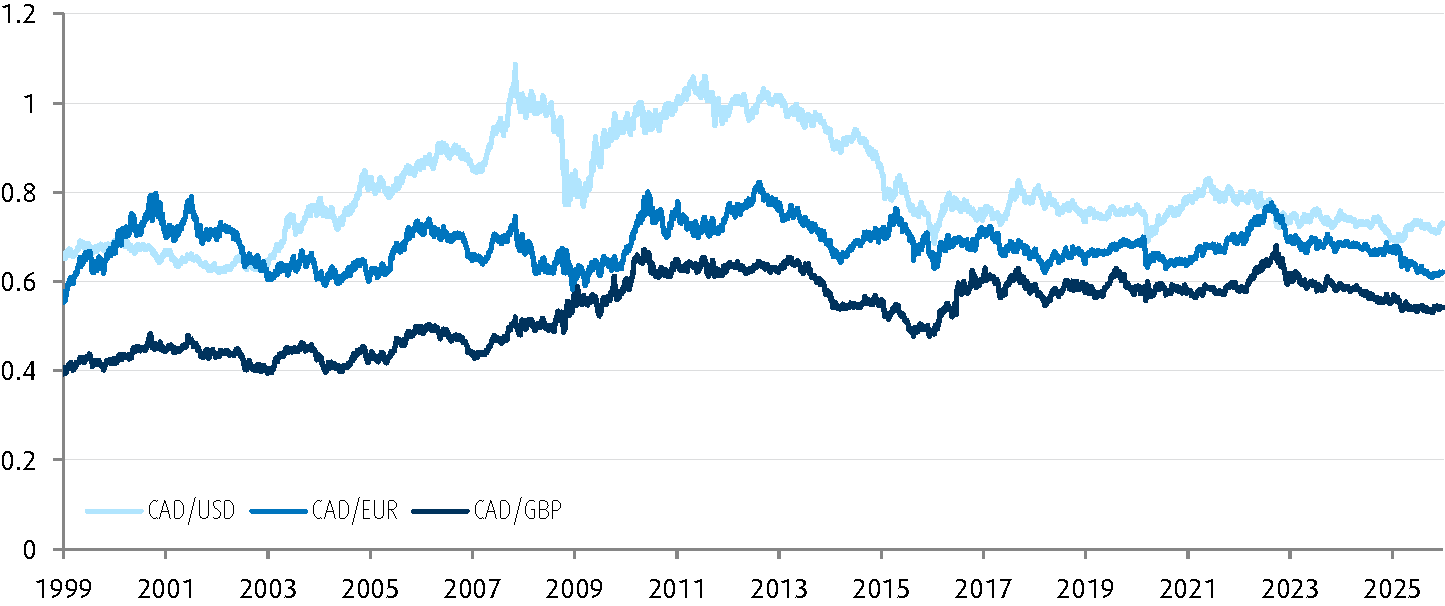 Source: Bloomberg and BMO GAM. Monthly value of CAD vs USD, EUR, GBP. As of December 31, 2025. Historical volatility is not an indication of future volatility.
The mechanics of hedging
The primary goal of currency hedging is to reduce the impact of foreign exchange (FX) movements on portfolio returns. In institutional settings, a blended approach is common, with portfolios often maintained at roughly 50% hedged and 50% unhedged, as noted in a BMO GAM ETF research whitepaper. Some managers actively adjust currency exposure in an effort to add value, while others remain fully hedged to minimize currency driven volatility.
In practice, hedging involves taking a short position in the foreign currency that corresponds to the underlying investment exposure. If the foreign currency depreciates relative to the Canadian dollar, losses on the equity holdings are offset by gains on the currency forward. Conversely, if the foreign currency appreciates, gains on the equities are partially offset by losses on the hedge.
Cost is another important consideration. Highly liquid currencies such as the U.S. dollar are generally efficient and inexpensive to hedge. By contrast, less liquid currencies, particularly those in emerging markets, can carry higher hedging costs and greater complexity.
The return of Canadian dollar against other major currencies
|
CAD vs. |
USD |
Euro |
Pound |
Yen |
|---|---|---|---|---|
|
2006 |
-0.31% |
-10.51% |
-12.33% |
0.78% |
|
2007 |
16.78% |
5.62% |
15.23% |
9.58% |
|
2008 |
-18.12% |
-14.51% |
11.34% |
-33.55% |
|
2009 |
15.90% |
13.00% |
4.54% |
18.76% |
|
2010 |
5.41% |
12.89% |
9.28% |
-7.96% |
|
2011 |
-2.31% |
0.85% |
-1.89% |
-7.35% |
|
2012 |
2.96% |
1.18% |
-1.48% |
16.06% |
|
2013 |
-6.60% |
-10.35% |
-8.37% |
13.39% |
|
2014 |
-8.59% |
3.84% |
-2.83% |
3.96% |
|
2015 |
-16.01% |
-6.43% |
-11.22% |
-15.71% |
|
2016 |
2.96% |
6.25% |
22.92% |
0.17% |
|
2017 |
6.91% |
-6.28% |
-2.34% |
3.04% |
|
2018 |
-7.83% |
-3.50% |
-2.40% |
-10.31% |
|
2019 |
4.99% |
7.37% |
1.06% |
4.00% |
|
2020 |
2.01% |
-6.36% |
-1.03% |
-2.99% |
|
2021 |
0.75% |
8.17% |
1.71% |
12.26% |
|
2022 |
-6.75% |
-0.86% |
4.38% |
6.24% |
|
2023 |
2.34% |
-0.81% |
-2.84% |
9.88% |
|
2024 |
-7.93% |
-1.80% |
-6.28% |
2.84% |
|
2025 |
4.80% |
-7.61% |
-2.66% |
4.50% |
|
|
20 Year Average |
|
||
|
|
-0.43% |
-0.49% |
0.74% |
1.38% |
|
|
Standard Deviation |
|
||
|
|
8.81% |
8.03% |
7.93% |
11.98% |
Source: BMO Asset Management Inc., Bloomberg. As of December 31, 2025.
Using BMO ETFs to access Nasdaq 100 exposure
Once the currency framework is established, advisors can invest in the Nasdaq 100 Index efficiently through two BMO ETF options:
- BMO Nasdaq 100 Equity Hedged to CAD Index ETF (ZQQ), which is CAD currency hedged for clients seeking to reduce the impact of currency movements.
- BMO Nasdaq 100 Equity Index ETF (ZNQ), which offers unhedged exposure in U.S. dollars and is also available in mutual fund form.
ZQQ – hedged to CAD
ZQQ removes U.S. dollar exposure using derivatives so returns align closely with the local‑currency (CAD) version of the index. This structure can be particularly useful when advisors expect Canadian dollar strength that could detract from unhedged U.S. equity returns.
It may also appeal to clients seeking a clearer link between index fundamentals and portfolio outcomes, with less foreign exchange noise and a focus on risk‑adjusted performance.
ZNQ – unhedged, in CAD (also available ZNQ.U in USD)
ZNQ, the unhedged version of the BMO Nasdaq 100 Equity Index ETF, maintains full U.S. dollar exposure. It is typically most appropriate when advisors expect U.S. dollar appreciation, when currency diversification benefits clients with CAD concentrated wealth and income streams, or when long-term investors can tolerate foreign exchange driven fluctuations and potentially benefit from multiyear U.S. dollar cycles.
With ZQQ and ZNQ, advisors have a Nasdaq 100 toolkit for aligning currency exposure with client objectives, risk profile and liabilities. By applying a disciplined hedging framework, wealth professionals can deliver more intentional, consistent, and transparent outcomes, strengthening both portfolio construction and client understanding.
For Financial Advisors Only
DISCLAIMERS
This article is sponsored by Nasdaq-100 Index (NDX).
This article is intended for information purposes only. This article has been prepared BMO Exchange Traded Funds (BMO ETFs), and represents their assessment at the time of publication. The views herein are subject to change without notice as markets change over time. The information contained herein does not constitute a solicitation of an offer to buy, or an offer to sell securities, and should not be construed as investment, tax or legal advice to any party. Particular investments and/or trading strategies should be evaluated and professional advice should be obtained with respect to any circumstance. Past performance is no guarantee of future results.
Index returns do not reflect transactions costs or the deduction of other fees and expenses and it is not possible to invest directly in an Index.
BMO Global Asset Management (BMO GAM) is a brand name under which BMO Asset Management Inc. and BMO Investments Inc. operate. BMO ETFs are managed by BMO Asset Management Inc., an investment fund manager, and a separate legal entity from Bank of Montreal. BMO Mutual Funds are managed by BMO Investments Inc., an investment fund manager, and a separate legal entity from Bank of Montreal.
Commissions, management fees and expenses (if applicable) all may be associated with investments in mutual funds and exchange-traded funds (ETFs). Trailing commissions may be associated with investments in mutual funds. Please read the fund facts, ETF Facts or prospectus of the relevant mutual fund or ETF before investing. Mutual funds and ETFs are not guaranteed, their values change frequently and past performance may not be repeated.
For a summary of the risks of an investment in BMO Mutual Funds or BMO ETFs, please see the specific risks set out in the prospectus of the relevant mutual fund or ETF. BMO ETFs trade like stocks, fluctuate in market value and may trade at a discount to their net asset value, which may increase the risk of loss. Distributions are not guaranteed and are subject to change and/or elimination.
Nasdaq® is a registered trademark of Nasdaq, Inc. (which with its affiliates is referred to as the “Corporations”) and is licensed for use by the Manager, BMO Asset Management Inc. The two BMO ETFs have not been passed on by the Corporations as to their legality or suitability. The ETFs are not issued, endorsed, sold, or promoted by the Corporations. The Corporations make no warranties and bear no liability with respect to these ETFs.
Third-party links and content:
This article may contain links to other sites that BMO Global Asset Management does not own or operate. Also, links to sites that BMO Global Asset Management owns or operates may be featured on third-party websites on which we advertise, or in instances that we have not endorsed. Links to other websites or references to products, services or publications other than those of BMO Global Asset Management in this article do not imply the endorsement or approval of such websites, products, services or publication by BMO Global Asset Management. We do not manage, and we are not responsible for, the digital marketing and cookie practices of third parties. The linked websites have separate and independent privacy statements, notices and terms of use, which we recommend you read carefully.
Any content from or links to a third-party website are not reviewed or endorsed by us. You use any external websites or third-party content at your own risk. Accordingly, we disclaim any responsibility for them.