Accelerating projects and cutting red tape top the priorities in a survey of 340+ leaders

Canadian business leaders want Ottawa to build major projects faster and attract more investment in the federal budget, a new KPMG Canada survey finds.
Finance minister François-Philippe Champagne will table the budget on Nov. 5, he announced early last week. KPMG surveyed 346 business owners and decision-makers before that date.
For wealth professionals, the results preview the tax and investment questions business-owner clients may raise as budget day nears.
Projects and investment lead the list
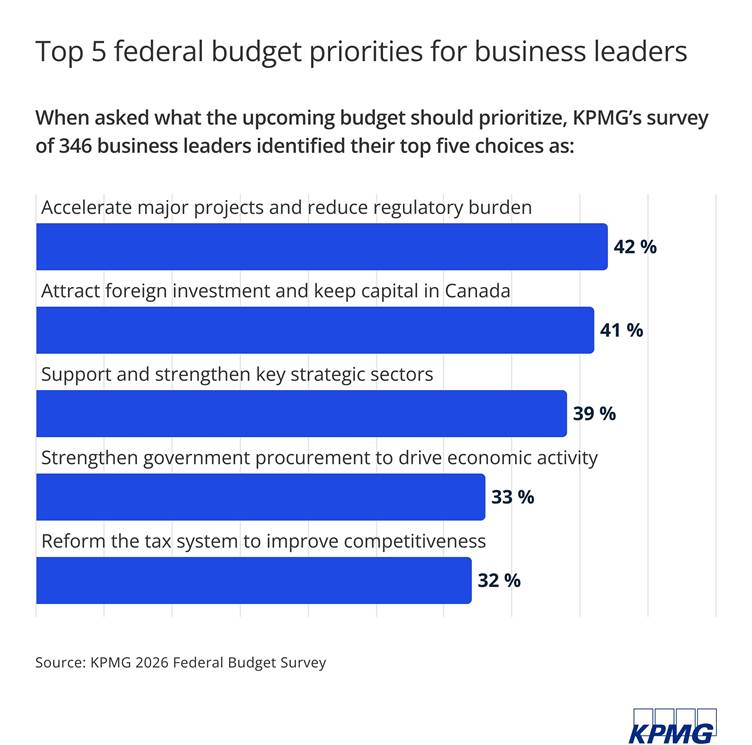
“Businesses are sending a clear signal that getting major projects moving is critical to Canada’s growth and competitiveness,” said Kaytlyn Barber, partner and national leader, infrastructure, capital projects and sustainability, KPMG Canada. She added that “the government can’t do it alone.”
Ali Jaffery, KPMG partner and chief economist, pointed to limited fiscal room. “An unforgiving bond market is giving all advanced economies less fiscal room to maneuver right now, but Canada can still make important gains through structural changes that support its broader economic agenda,” he said. “Streamlining regulations is a low-cost, effective way to improve the investment climate.”
The Parliamentary Budget Officer now expects a $63.3 billion deficit in fiscal 2026-27, down from $71.8 billion in its June outlook.
Mega deduction wins support; tax reform divides
The survey also tested the Productivity Mega Deduction, announced Sept. 15. It lets businesses immediately deduct the full cost of a broader range of eligible investments. The government expects it to cost $36 billion over five years.
Over the next one to five years, business leaders said the deduction would:
- Encourage investment in new machinery, equipment, technology and capital projects: 51%
- Increase their investment in Canada: 49%
- Improve Canada’s global investment competitiveness: 45%
- Accelerate investments already under consideration: 44%
Support was strongest in capital-intensive sectors. Among agriculture, automotive, construction and manufacturing respondents, 69% said it would encourage new investment.
“If a project is close to the line, improving the tax economics could be enough to move it forward,” said Lachlan Wolfers, national leader, KPMG Law.
Respondents also want broader change. Some 87% support a comprehensive tax system review, 85% want a simpler system, and 88% want stronger investment incentives. Further, 52% want lower taxes on capital, and 49% want a lower corporate tax rate.
There is less agreement on paying for cuts. Respondents ranked how major tax reductions should mainly be funded:
- Cutting government operating spending: 35%
- A mix of higher consumption taxes, lower operating spending and borrowing: 32%
- Curbing new “nation-building” investments: 14%
- Raising other taxes, such as the GST: 11%
- Increasing government borrowing: 8%
“These findings underscore how difficult the tax reform debate is in practice,” said Brian Ernewein, KPMG senior advisor, National Tax. “While some proposals call for shifting more of the tax burden from income to consumption, there is no clear consensus among business leaders on how to fund lower taxes and offset lost government revenue.”
KPMG surveyed members of the Angus Reid Forum from Sept. 22 to Oct. 2.