David Stonehouse shares where he sees risks, insulation as President Trump turns up the volume
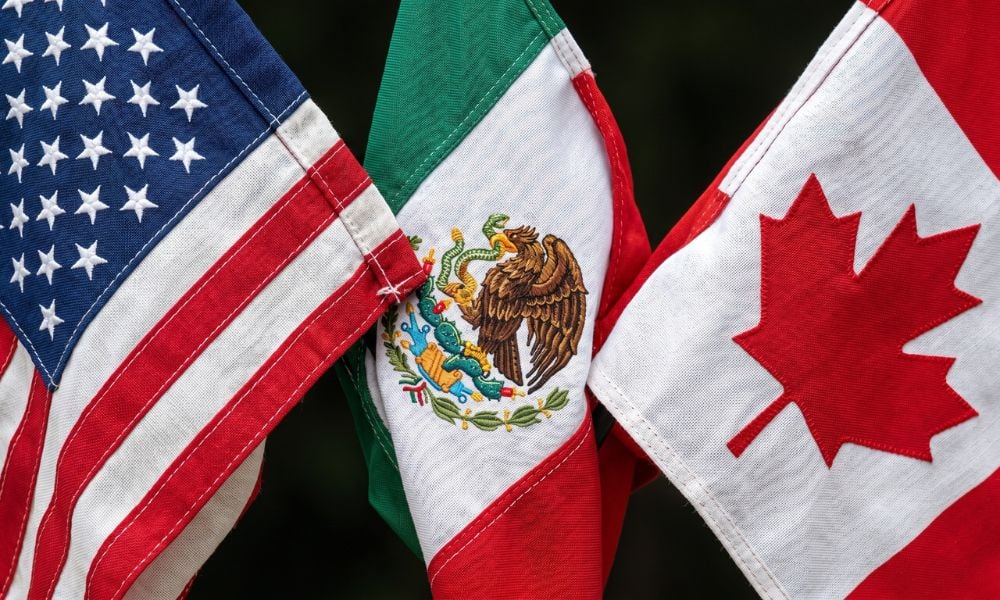
Donald Trump knows how to play to his audience. The US President has proven himself, time and again, to be an effective headline grabber and savvy media operator, especially when his goal is to induce confusion and panic. As Canada and Mexico now walk into a renegotiation of the Canada US Mexico Agreement (CUSMA), We can expect the President to do exactly what he has tended to do well in the past: turn up the volume.
David Stonehouse, Senior Vice-President and Head of North American and Specialty Investments at AGF Investments, acknowledges that all this noise may prove challenging for Canadian investors and their advisors. The President’s tendency to prevaricate, provoke, and walk back plays well to a media ecosystem that lives off scary headlines. While advisors need to stay aware of this dynamic, Stonehouse believes advisors can still find signals in the noise and take some heart from more structural forces protecting their clients from worst-case scenarios.
“It’s the early stages of things where you don’t want to get too hung up on what you’re hearing. The trick will be to try to glean some sense of substance from the style, some signal from the noise,” Stonehouse says. “That will likely not happen on July 2nd. I would think your opening gambit is going to be classic negotiation tactics and you’re not going to come out of the gate with your final offer. Your best offer and a ballot, a legitimate one. I would expect that the noise ratio was higher at the outset and then it starts to move towards something more concrete over time.”
Why CUSMA will change, but shouldn’t end
The best case scenario, a re-signed CUSMA deal on July 1st with no changes, is already off the table as per the President’s comments. Stonehouse also believes that a worst-case scenario, the deal being dissolved entirely, is also highly unlikely. He notes the simple fact that the United States needs so many goods produced in Canada. US geopolitical interests are served by a close relationship with Canada, so wholesale abandonment of this trade deal should not be of service to the United States. The likely outcome, therefore, is a deal with some marginal tweaks.
In watching the comments made during these renegotiations, Stonehouse says there can be lessons learned from the recent conflict between the United States and Iran. In the wake of a structured ceasefire deal there were a number of false starts, outright prevarications, and an eventual circling towards a more valid core deal. What we saw, though, was increasing alignment in comments made by both US and Iranian officials, which preceded the eventual deal. Stonehouse believes that when we see similar alignment between the officials renegotiating CUSMA, we will see the new deal take shape.
Stonehouse expects specific sectors to fall into Trump’s crosshairs in these renegotiations, and he believes we’ve already seen the sectors the US will focus on in their tariff policies to date. Steel, aluminium, and automobiles will take center stage, even over the perennial problems that stem from softwood lumber and dairy. He says that investors should take some solace from this. While those sectors are significant parts of the Canadian economy, they don’t represent a major force on Canadian equity markets.
Where markets will feel CUSMA risk
“There are going to be two major impacts of all these negotiations that we’re going to have to keep an eye on,” Stonehouse says. “One is the impact on the economy and the other is the impact on the capital markets. By and large a lot of the sectoral issues that are going to be at play in the coming weeks and months are not strongly represented in the Toronto Stock Exchange.”
The TSX’s heavy weight towards financials, energy, and commodities means that it should remain largely insulated from risks that may emerge, or appear to emerge, during CUSMA renegotiations. Where we may see risks, however, is on bond and foreign exchange markets.
Canadian bonds and the Canadian dollar, Stonehouse says, offer more direct exposure to the Canadian economy. If these renegotiations hit certain sectors particularly hard, or if they cause small and medium sized enterprises to hold off on investment, then the bond market may react. Since a best case scenario is already off the table, Stonehouse believes the renegotiations will likely end up slightly worse for the Canadian economy, which should push interest rates lower. That has already started to be reflected in the Canadian bond market, which has seen yields fall faster than in the United States.
The Canadian Dollar will also potentially weaken, in part due to a strengthening US dollar powered by other geopolitical shifts. Stonehouse notes, though, that some of the ongoing weakness in CAD may reflect broader economic uncertainty around the state of the Canadian economy under a new CUSMA deal.
How advisors need to contextualize the news
It will be up to advisors, now, to provide their clients with context and reassurances that can offset some of the panic and fear this renegotiation cycle will inevitably induce. At baseline, Stonehouse cautions against too much reactivity and advises patience and calm. He stresses that a substantial trade relationship between Canada and the United States will remain in place, whatever happens.
Those with more of a ‘trader mindset’ may try some sector-specific plays, but Stonehouse believes that most advisors and most clients need to look through headline risks, and consider some strategies to help insulate them in the long-term.
“You may, at the margin, try to insulate yourself a little bit just by owning a little bit more bonds than you otherwise might. I wouldn’t go nuts with that. But I think you can argue for just a little bit more if you’re really concerned,” Stonehouse says. “But I would not counsel much of an active adjustment associated with this. I would tend to want to look through this.”