The stock fell about 16% on Monday for its biggest single-day drop since its June 12 listing
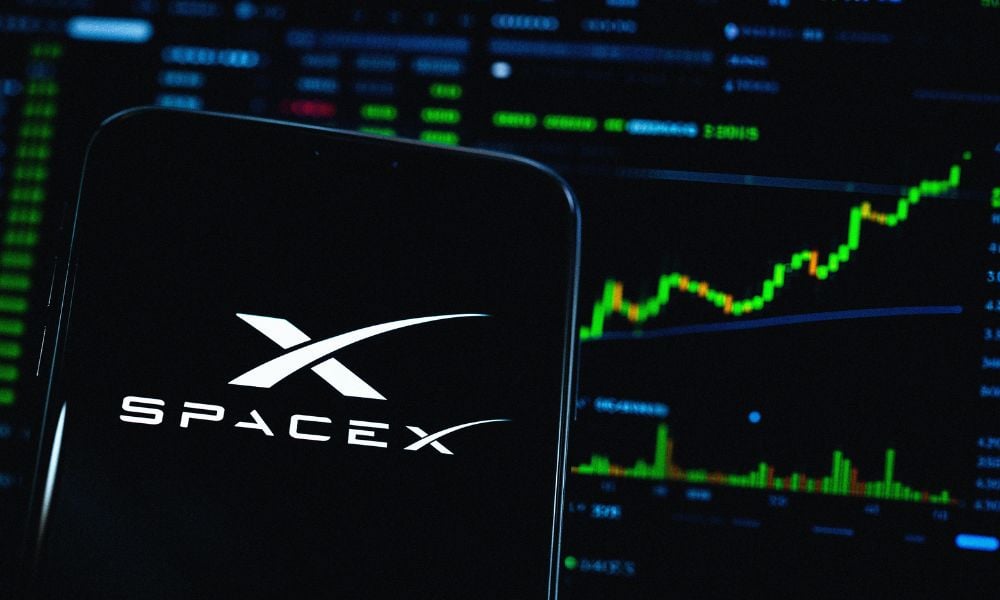
SpaceX has lost nearly a quarter of its value in three trading sessions, leaving investors who bought in the open market after its June 12 debut with almost none of their early gains.
According to Yahoo Finance, the stock fell about 16 percent on Monday for its biggest single-day drop since listing, closing down 16.4 percent.
That followed declines of 5 percent on Wednesday and 3.6 percent on Thursday last week, leaving shares only 14 percent above the US$135 IPO price after they opened at US$150.
At one point the stock hit around US$225, and CNBC noted SpaceX had briefly passed Amazon and Microsoft to become the fourth-most-valuable public company.
The selloff coincided with SpaceX's first-ever bond offering, announced Monday.
Reuters noted that debt offerings can weigh on share prices as investors weigh interest expense and a company's need for additional funding.
Sources told CNBC the company wants to raise US$20bn, with the sale expected to begin as early as Tuesday.
SpaceX did not disclose the size or pricing of the senior unsecured notes, according to Reuters, but said proceeds will repay its bridge loan in full and cover general corporate purposes.
Yahoo Finance traced that bridge loan to February, when SpaceX acquired Musk's xAI startup, with Bank of America, Citigroup, JPMorgan Chase, Goldman Sachs and Morgan Stanley providing the financing and expected to run the deal.
The debt route lets Musk avoid diluting shareholders.
Reuters reported that he holds 82 percent of the company's voting power after the IPO.
Adam Sarhan, chief executive of 50 Park Investments, told the wire service that because Musk keeps "supermajority voting control through a dual-class structure," bonds let the company raise money without diluting shareholders.
The choice of debt over equity "clearly prioritizes avoiding further shareholder dilution," he said.
The same outlet reported that credit rating agencies assigned SpaceX investment-grade ratings last week, with Moody's issuing a "Baa1" and Fitch a "BBB+", indicating moderate credit risk and sufficient capacity to meet its commitments.
On the balance sheet, CNBC put SpaceX's cash and cash equivalents at about US$100.8bn as of June 19, up sharply from the US$15.9bn it held at the end of March, per its IPO filing cited by Reuters.
Lock-up expiries loom as a further pressure point.
Jeff Jacobson, a strategist at 22V Research, told Yahoo Finance that a 20 percent insider unlock follows the company's earnings announcement in early to mid-August, with further unlocks tied to the share price and to dates in late August and September.
By early September, Jacobson said, insiders could sell as much as 44 percent of SpaceX shares, increasing the float by about 900 percent from its current level of around 4.2 percent.
The fundamentals behind the volatility remain unprofitable.
CNBC reported a US$4.9bn net loss in 2025 and a US$4.28bn loss in the first quarter, while Reuters put revenue up 33 percent to US$18.67bn last year.
Spending on AI infrastructure and the next-generation Starship rocket has weighed on profitability despite growth at Starlink and CNBC reported that the company plans to keep funding AI initiatives that include buying chips and building data centres in space.
The IPO raised nearly US$86bn after underwriters exercised the greenshoe allotment, made Musk the world's first trillionaire and minted thousands of new millionaires, with some shareholders' stakes passing the US$1bn mark.
Drawing on FactSet data, the outlet flagged several holders worth more than US$1bn.
The largest was Valor Equity Partners at around US$96.6bn, followed by PayPal cofounder and board member Luke Nosek at US$6.3bn, president and chief operating officer Gwynne Shotwell at US$2.4bn, and chief financial officer Bret Johnsen at US$1.2bn.
Reuters compared the stock's turbulent first week to Tesla's 2010 debut.