Advisors should be watching change on the secondaries market now


Ask a private equity investor what worries them in 2026 and the answer is rarely returns on paper. It is cash.
The DPI drought
For most of its history, a PE fund bought companies, improved them and sold them within four or five years, sending cheques back to investors along the way. The measure that captures those cheques is DPI — distributions to paid-in capital. A DPI of 1.0x means investors have received back every dollar they contributed; anything above that is realized profit. Unlike TVPI (total value, including unrealized marks) or IRR, DPI cannot be revised later, because it counts cash rather than opinions about value.
By that measure the industry is in a drought. Bain reports that buyout funds distributed just 14% of net asset value (NAV) in 2025, after a decade-low 11% in 2024 — four consecutive years below 15%, against a 2014–17 average of 29%. Venture is worse: median DPI for 2019-vintage funds sits at 0.16x and for 2021 vintages at 0.05x, versus 1.68x for 2014 (PitchBook). Growth equity sits in between, sharing venture's dependence on IPOs and buyout's on leverage.
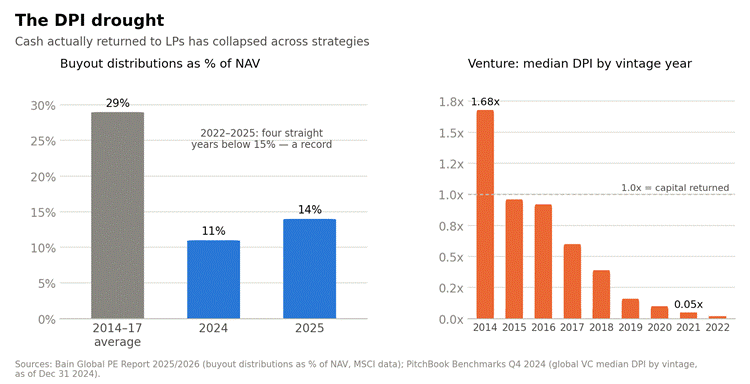
Figure 1. Distributions have fallen across strategies, most severely in venture.
The cause is a stalled exit market. Bain counts circa 32,000 unsold buyout-backed companies worth US$3.8 trillion, and the average hold at exit has stretched to about seven years from five or six in the 2010s. Canada is no exception: CVCA recorded no PE- or VC-backed IPOs in 2024 or 2025, and first-half 2026 exits were carried by two deals — the Apotex IPO and the Amica sale.
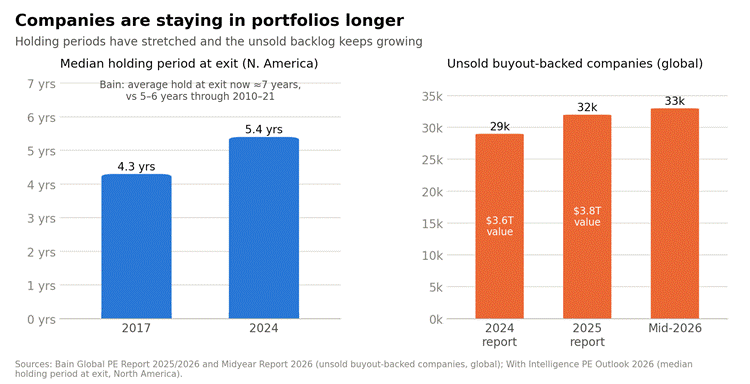
Figure 2. Longer holds and a growing backlog of unsold companies.
How managers have improvised
General partners (GPs) have responded with liquidity that is not quite an exit. Dividend recapitalizations — borrowing at the portfolio company to pay investors — reached US$72 billion in 2025, the second-highest year on record (PitchBook LCD). NAV loans, borrowed against the fund itself, have grown from a niche into a market 17Capital projects at US$145 billion by 2030. Distributions in kind — handing limited partners (LPs) shares instead of cash, most visibly Valor's US$8.5 billion SpaceX distribution this month — push the sale decision onto the investor. In private credit, circa 12% of loans now pay some interest in kind (PIK) rather than cash (FSB). And fund lives keep stretching: MSCI puts NAV in funds past their expected liquidation age at a record US$250 billion.
Secondaries step in
This is the gap secondaries fill. A secondary is simply the purchase of an existing private markets position rather than a commitment to a new blind-pool fund. It takes two forms:
- LP-led: an investor sells its stake in a fund, or a portfolio of stakes, to a buyer, usually at a discount to NAV. Buyout stakes cleared at circa 91% of NAV in the first half of 2026; venture at 79% (Jefferies).
- GP-led: the manager moves one or more companies into a new "continuation vehicle," giving existing investors the choice to cash out or roll over, with secondaries funds supplying the fresh capital.
Volume has tripled since 2019 to US$240 billion in 2025, and the first half of 2026 set a record at US$118 billion, with GP-led deals now the majority; continuation vehicles accounted for circa 14% of sponsor-backed exits. Capital has followed: Preqin puts secondaries AUM at US$522 billion, forecast to reach US$1.3 trillion by 2030, with 216 funds in market seeking US$115 billion. The market is also maturing beyond diversified flagships such as Ardian's US$30 billion ASF IX into infrastructure, private credit, real estate and venture specialists — and Toronto's Dawson Partners closed US$7.7 billion for portfolio financing last year.
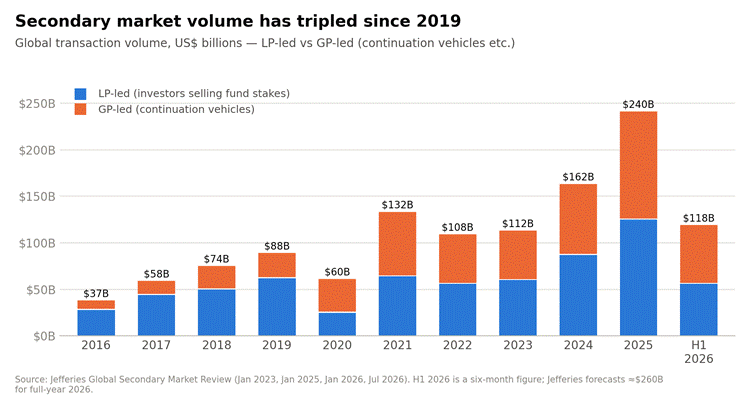
Figure 3. Secondary volume by deal type, 2016–H1 2026.