A national survey pins the answer on the Prairies as Vancouver and Toronto lose ground

A detached home in Regina gained 13 percent per square foot in the first six months of 2026 even as Vancouver condo prices fell almost 15 percent, a split that shows how unevenly the country's housing market has moved this year.
The figures come from CENTURY 21 Canada's latest Price per Square Foot survey, which also reported Toronto condos down close to 8 percent over the same period, while Regina's detached gain was the largest in the country.
Even after that jump, a square foot of detached housing in Regina still costs less than half what a Vancouver or Toronto condo commands, the firm said.
The survey, now in its ninth year, tracked sales across 50 communities between January 1 and June 30 and compared them with the same period in 2025.
It found prices softening nationally while diverging sharply by region and, in many cases, by neighbourhood.
Todd Shyiak, executive vice-president of CENTURY 21 Canada, said the market has been soft this year but the pricing story is "a diverse one," with variation down to the individual neighbourhood.
The data shows people moving out of big-city cores toward "larger communities where you can get more home for your dollar," he said, while prices in the Prairies and, to a lesser extent, Alberta and Atlantic Canada hold up better.
 Source: CENTURY 21 Canada
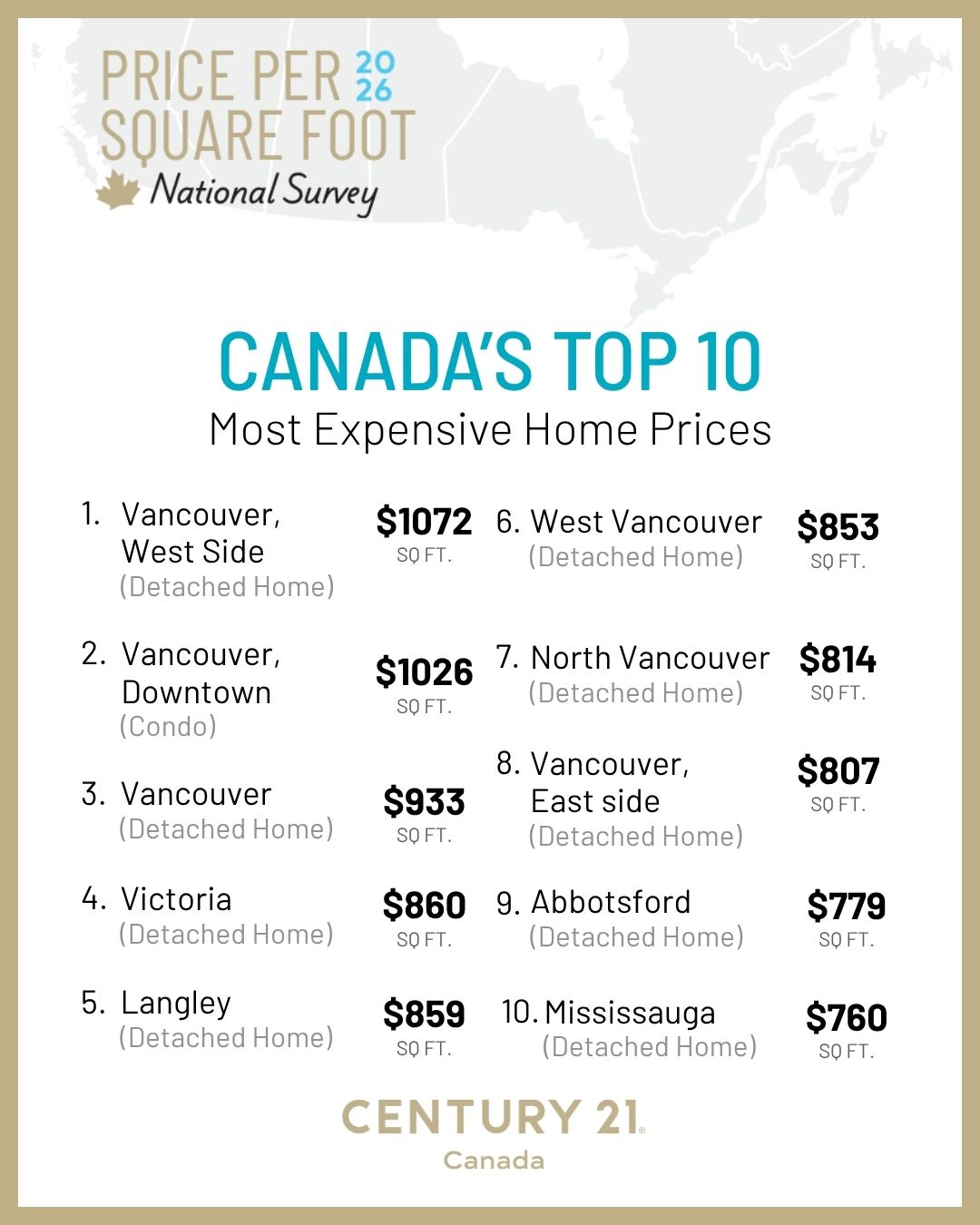
The firm ranked Vancouver's West Side as the priciest market at $1,072 per square foot for a detached home, followed by downtown Vancouver condos at $1,026 and detached homes elsewhere in the city at $933.
Victoria, Langley, West Vancouver, North Vancouver and Vancouver's East side filled much of the top 10, with Mississauga the only Ontario entry, at $760.
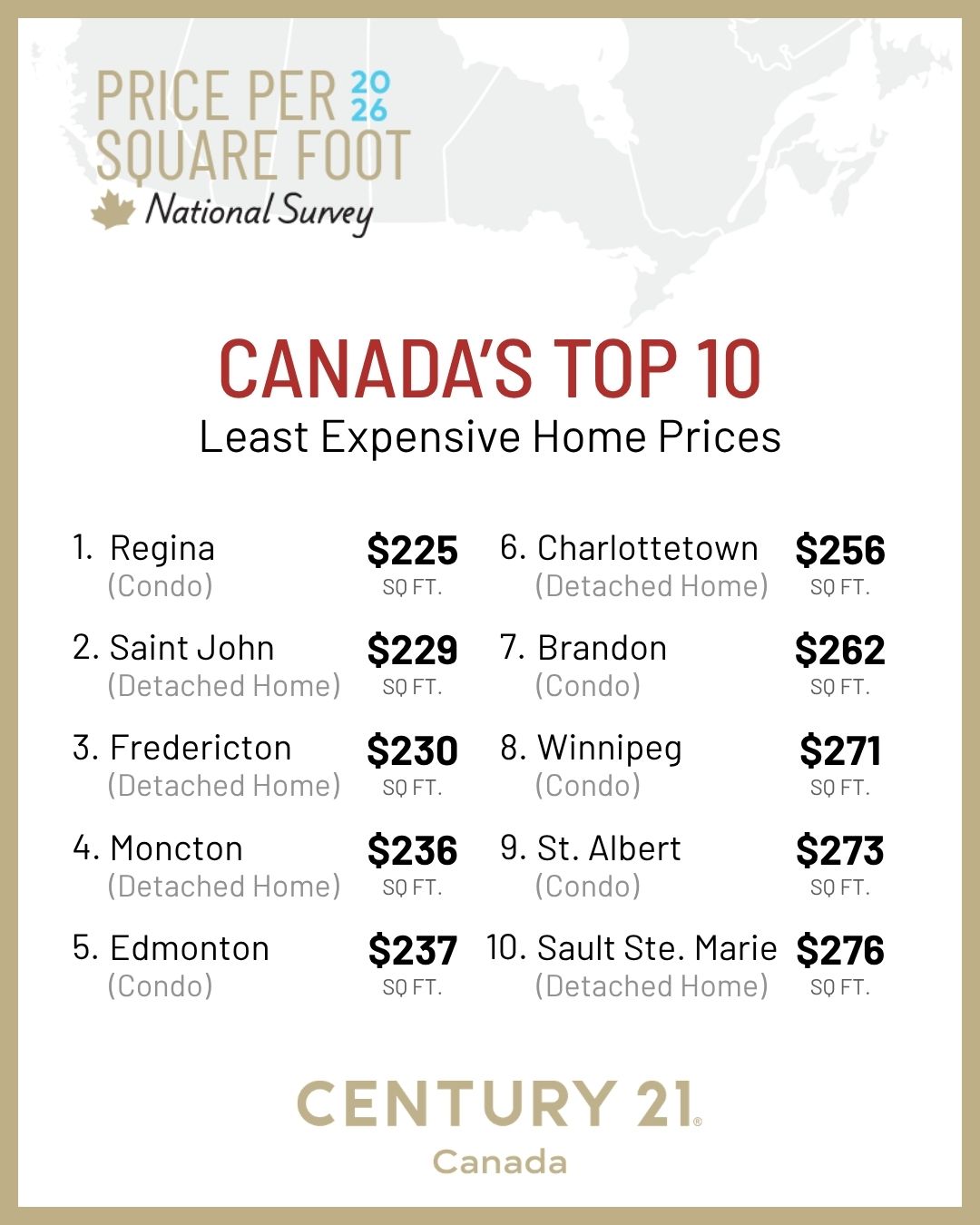
At the other end, Regina condos were the cheapest in the survey at $225 per square foot, ahead of detached homes in Saint John at $229 and Fredericton at $230.
British Columbia holds the country's priciest markets but has not escaped the slowdown.
Buyer uncertainty pushed Vancouver's condo and detached prices down by nearly 15 percent, while the suburbs of Richmond, North Vancouver and White Rock recorded declines of about 10 percent.
Those drops follow several years of steep gains, and prices in many of those communities have returned to pre-pandemic levels while Kelowna and Victoria held essentially flat.
Rhiannon Foster, an agent with CENTURY 21 In-Town Realty in Vancouver, said well-priced homes still move quickly even as prices fall.
Buyers who waited now hold "negotiating power that hasn't been possible in a very long time," she said, with more choice and time to decide.
She expects less impact from the recent government plan to buy unsold condo inventory.
It will help developers and possibly free up their capital, Foster said, but affordability will remain the main driver for resale buyers.
Scarce listings drove Ontario's difficult first half, the survey found, with some markets going months without a single sale and prices falling across the board, though Hamilton edged up.
Shyiak said many of the firm's Ontario brokers are reporting "the tightest market" most of their agents have seen in their careers.
Thin inventory and buyers stuck in "wait-and-see" mode are driving a hard climate, he said.
In Mississauga, added to the survey this year, detached homes carry one of the highest price points in the province.
Nelson Goulart, owner of CENTURY 21 Signature Service there, linked the decline, which he said has run steadily since 2022, to two overseas wars and tariffs levied against Canada.
"I believe we're at the bottom of this market, so even though we've been bruised by the start of this year there's some optimism for the fall markets," he said.
 Source: CENTURY 21 Canada
The Prairies posted Canada's strongest results, as per the survey, extending a multi-year trend.
Regina's 13 percent gain in detached homes led the country, with Brandon, Winnipeg and Saskatoon close behind in the same category, and only Regina and Brandon condos slipped, then only slightly.
Alberta prices eased modestly, the firm said, a reversal from 2025 when it was the only province to rise across the board.
Calgary and Edmonton held steady while smaller centres such as Red Deer and St. Albert gained.
Geneva Tetrault, owner of CENTURY 21 Masters in Edmonton, said the region has "really settled into a balanced market."
Deals are still happening and agents are busy, she said, but without "the urgency and panic around every transaction" seen in the past.
On the Island of Montreal, condos recorded their first dip since the survey began, though a slight one, while detached homes rose nearly 6 percent.
In Atlantic Canada, declines stayed under 10 percent, with small increases in Charlottetown and Halifax.
Joel Ives, owner of CENTURY 21 Colonial Realty in Charlottetown, pointed to a standoff between buyers and sellers.
He tied it to rising living costs that keep move-up buyers and downsizers on the sidelines, leaving the market at "a bit of a stalemate."
Now in its ninth year, the survey tracked sales of comparable properties across 50 communities between January 1 and June 30, measuring them against the same period in 2025.
CENTURY 21 Canada draws the figures from sales its franchises report. This year the firm added Mississauga in Ontario along with Surrey, Abbotsford and Langley in British Columbia.