Citigroup and JPMorgan lifted their targets as AI earnings powered the rally
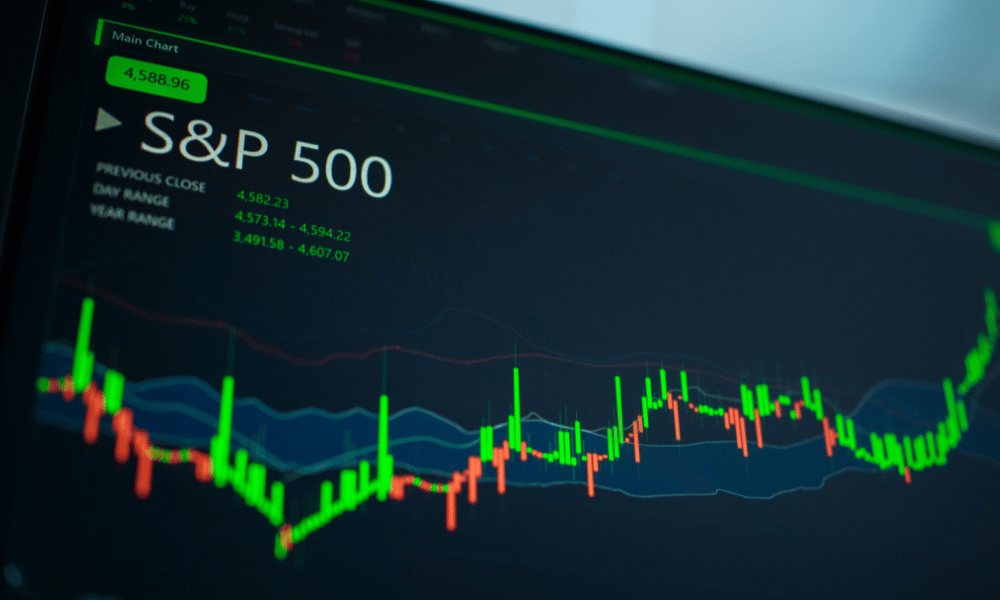
Five Wall Street banks now see the S&P 500 finishing 2026 at or above 8,000, even as the OECD and World Bank warn that war in the Middle East has knocked the legs out from under global growth.
The split sets up a sharp test for portfolios betting on artificial intelligence to outrun an energy shock.
JPMorgan strategist Dubravko Lakos-Bujas lifted his year-end target to 7,800 from 7,200, implying 5.9 percent upside, according to CNBC.
He said stocks are heading into a "'Blue Sky' scenario" as the US-Iran war moves toward resolution, but warned the climb will not be smooth.
"The path upwards will likely be non-linear, as the market will need to clear various hurdles," he wrote to clients, noting that strong back-to-back earnings have "reset the bar higher" for the second quarter.
Citigroup pushed its target to 8,100 from 7,700 two weeks ago, citing earnings resilience and AI-driven growth, as reported by Reuters.
The firm raised its 2026 earnings-per-share forecast to US$350 from US$320 and floated a US$400 mark for 2027.
"We have high confidence in continued earnings beats through year-end," Citi said in a June 5 note, while cautioning that the "persistence of AI-driven growth beyond 2027 remains a key question."
The firm framed the rally as "a one-time capex supercycle" rather than a traditional cycle.
Barclays and Stifel each moved to 7,800 on Tuesday, per Reuters, roughly 4.4 percent above the index's last close of 7,472.79.
"The equity bull case remains intact, but earnings and AI capex visibility must do more of the work as Fed support fades," Barclays analysts led by Venu Krishna wrote.
The bank lifted its 2026 EPS forecast to US$337 from US$321, set a 2027 target of 8,800, downgraded financials to "neutral" and upgraded healthcare to "neutral."
The earnings story underpins the bull case.
S&P 500 profits grew almost 14 percent year on year in the fourth quarter of 2025, then 28.9 percent in the first quarter of 2026, with second-quarter growth seen at 22 percent, according to CNBC, citing FactSet.
Expectations for full-year 2026 earnings growth have jumped from 16 percent in early January to almost 25 percent, Reuters reported, citing LSEG data.
The last time annual profit growth ran higher was in 2021, said Tajinder Dhillon, head of earnings research at LSEG.
Not everyone is chasing the megacaps higher.
"Stock concentration sits at 40-year highs," Stifel's Thomas Carroll said, per Reuters, signalling a rotation out of mega-caps into equal-weight indices.
He favours cyclical sectors such as energy, industrials, materials and select semiconductors.
The risks are concentrated in rates and energy.
A Reuters poll last month pegged the index at just 7,620 by year-end, with nine of 13 respondents calling a correction in the next three months unlikely.
"What's different now is we have higher energy prices, rates moving higher, and we are seeing inflation becoming more entrenched," said Anthony Saglimbene, chief market strategist at Ameriprise, who holds a 7,500 target.
Futures markets are now pricing in a potential Federal Reserve rate hike later in 2026, Reuters reported, a reversal from the cuts expected at the start of the year.
Barclays put it bluntly: "We believe yields are re-centering as a key risk factor for equities."
Even AI skeptics see near-term upside.
Major companies are racing to understand the new technology, and that "AI arms race will likely lead to higher prices in the short run," said Chris Zaccarelli, chief investment officer at Northlight Asset Management. He carries the Street's high mark of 8,300.
According to Reuters, semiconductors have risen more than 80 percent since the end of December, and Nvidia announced an US$80bn buyback last week.
The macro backdrop tells a darker story.
The OECD said the Middle East conflict has become "the dominant force shaping global economic prospects," triggering an energy shock that is lifting inflation and weighing on growth.
Under its baseline scenario, global growth slows from 3.4 percent in 2025 to 2.8 percent in 2026, with US growth at 2.0 percent.
A prolonged disruption would cut global growth to 2.1 percent and push G20 inflation well above the 4.0 percent the OECD already expects in 2026.
"The global economy entered 2026 with robust momentum, but the outlook has weakened significantly since the start of the conflict in the Middle East," OECD Secretary-General Mathias Cormann said.
He urged governments to keep any fiscal support "targeted towards those most in need and temporary."
The World Bank cut its 2026 global growth forecast to 2.5 percent, its lowest since the pandemic, and said growth could fall to 1.3 percent if energy disruptions deepen and rattle financial markets, Reuters reported.
Its baseline assumes Brent crude averaging US$94, up 36 percent from 2025.
Deputy chief economist Ayhan Kose said the outlook could weaken fast if energy and financial pressure "reinforce each other."
Chief economist Indermit Gill was blunter, calling the world economy "a lot less resilient today than it was in 2008."
The bank held US growth at 2.2 percent for 2026 but sees it tapering to 2 percent by 2028, per Reuters, with the euro area at 0.8 percent and China at 4.2 percent.
India remains the fastest-growing large economy at 6.6 percent.
Selected 2026 S&P 500 targets
|
Brokerage |
Target |
|---|---|
|
BofA Global Research |
7,100 |
|
Wells Fargo |
7,950 |
|
Goldman Sachs |
8,000 |
|
Morgan Stanley |
8,000 |
|
Citigroup |
8,100 |
|
Oppenheimer Asset Management |
8,100 |
Source: compiled by Reuters