AI adoption, career mobility, and trust define Canada’s best wealth management firms to work for in 2026
An industry under pressure
Canada’s best wealth management firms to work for in 2026 share one trait that has nothing to do with salary bands or ping-pong tables: nerve. Introduce AI badly, and you risk hollowing out the trust that keeps good people from walking. Introduce it well, and it becomes the reason they stay. The organizations recognized in Wealth Professional’s 2026 Top Employers report have chosen the harder, slower path – treating AI adoption as something to be explained, governed, and earned, rather than quietly rolled out and hoped for the best.
That choice isn’t optional goodwill. Employees currently hold the leverage. According to Natalie Kassen, president and founder of Kassen Recruitment in Toronto, there are 20 percent more accounting jobs in Canada than there are accountants to fill them, and Chartered Professional Accountant (CPA) enrollment has dropped 13 percent over the past two years. Candidates know it, and they’re negotiating as they know it – for better pay, more flexibility, and employers who won’t waste their time with AI theater.
Against that backdrop, this year’s Top Employers were selected through a two-phase process: organizations first completed an employer submission form outlining their workplace offerings, after which their own employees anonymously rated the workplace across metrics including compensation, benefits, development, and culture. Only organizations that achieved an average employee satisfaction rating of 80 percent or greater, having met a minimum response threshold based on company size, were named Top Employers for 2026.
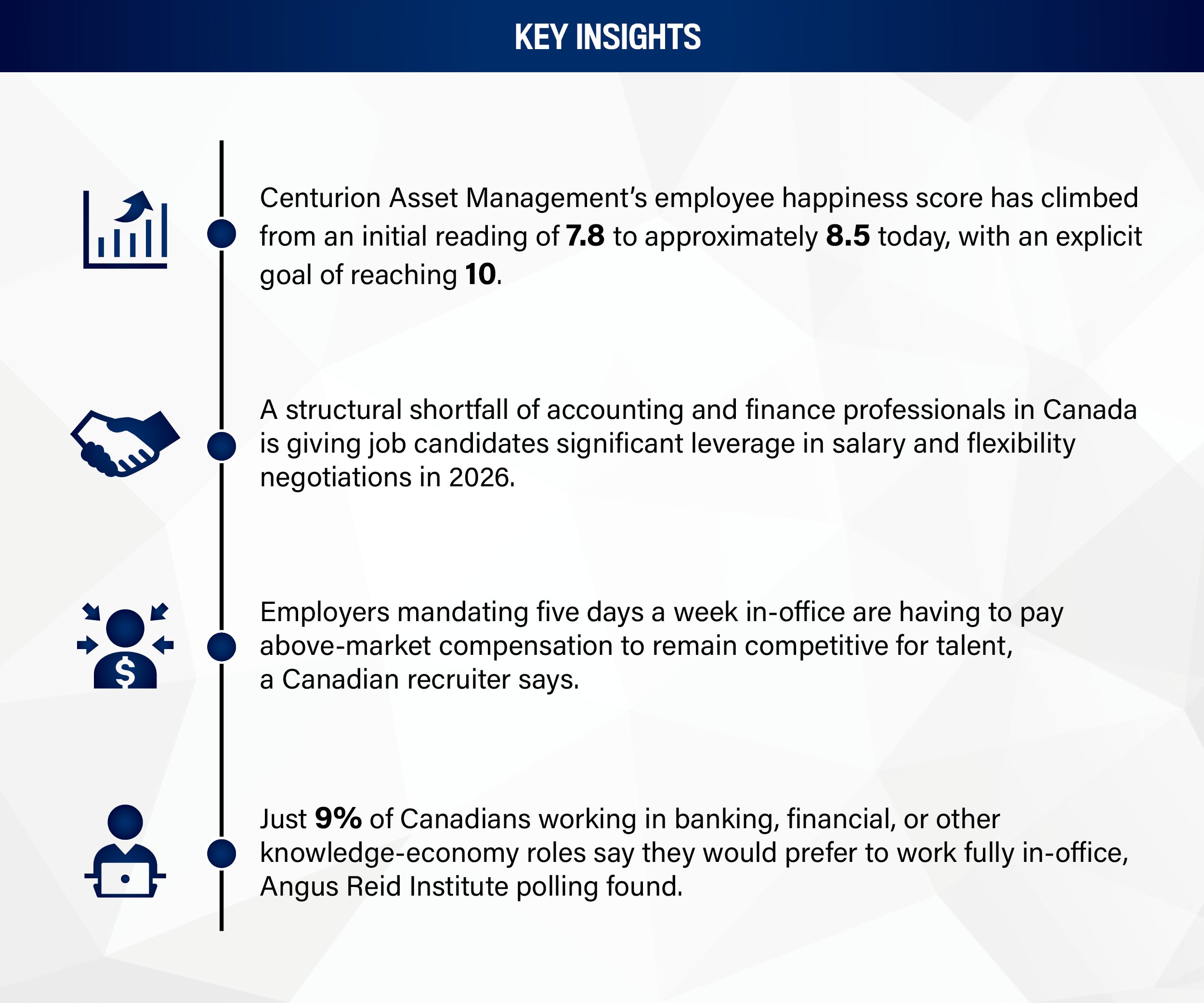
That timeline lines up with broader industry movement. Reporting from HRD Canada on the return-to-office push found that Canada’s Big Six banks led a coordinated tightening of in-office requirements through 2025 and into 2026, while the federal government moved executives to five days a week onsite starting in May 2026, with the wider public service following at four days by July 6, 2026. Angus Reid Institute polling from September 2025 found that just nine percent of Canadians working in banking, financial, or other knowledge-economy roles said they would prefer to work fully in-office – a gap that helps explain why rigid attendance policies carry a real recruitment cost.
Wealth Professional Canada · Top Employers 2026
The return-to-office squeeze when mandates outpace preference
As Canadian banks and government tighten in-office requirements, most employees in banking, financial, and knowledge-economy roles want the opposite — a gap that is quietly reshaping how employers compete for talent in 2026.
9%
of Canadians working in banking, financial, or other knowledge-economy roles say they would prefer to work fully in-office
Angus Reid Institute polling, September 2025
The mandate moved faster
2025 – early 2026
Canada's Big Six banks lead a coordinated tightening of in-office requirements across the sector.
January 2026
Several major banks and accounting firms introduce five-day in-office mandates.
May 2026
The federal government moves executives to five days a week on-site.
July 6, 2026
The wider federal public service follows, moving to four days a week on-site.
the in-office taxDefined
The above-market compensation employers must increasingly offer when they require five days a week on-site — because rigid attendance policies significantly narrow the pool of candidates willing to apply.
What makes a top wealth management employer in Canada in 2026?
Flexibility remains the single biggest differentiator employers are using to compete for a shrinking talent pool, says Kassen. “People don’t want to be watched,” she says. “They don’t want that nine-to-five typical work life. They do want their hours tied to outcomes.” For organizations that have offered hybrid or remote work throughout much of their employees’ careers, that flexibility has become the baseline expectation rather than a perk – and a growing share of candidates simply won’t consider a fully in-office role, regardless of other incentives.
That expectation is colliding with an industry-wide return-to-office push that began in January 2026, when several major banks and accounting firms introduced five-day in-office mandates. Kassen says this has created what she calls an “in-office tax”: organizations requiring five days a week on-site now have to pay above-market compensation to remain competitive, because rigid attendance policies significantly narrow the pool of candidates willing to apply. Employers are responding by increasing Registered Retirement Savings Plan (RRSP) matching, adding transit benefits, and, in some cases, creating new career progression levels – such as assistant manager roles – that didn’t previously exist at some accounting firms.
AI is reshaping expectations of what early-career finance professionals should be doing with their time. Where junior roles once centred on data entry and historical record-keeping, Kassen says the expectation now is that employees contribute strategically from day one. “The value in finance professionals is not just recording numbers but also really being able to understand the story that they tell,” she says. Professionals who focus on developing analytical and storytelling skills, rather than tasks that are increasingly automated, will be the most attractive to employers going forward, she adds.
Diversity, equity, and inclusion (DE&I) initiatives are also facing closer scrutiny from employees themselves. Kassen says staff can distinguish between DE&I efforts that exist for external branding purposes and those genuinely embedded in how people are treated day to day. “It really can’t stop at the hiring stage,” she says. “The real test is really, you know, when someone walks through that door, how are they treated? Are they measuring stats in terms of succession planning and mentorship? Are they looking at who is actually at the table or who has access to leadership?”
That squeeze is visible in national hiring data too. Robert Half’s 2026 Canada Salary Guide found that 68 percent of finance and accounting managers say they are struggling to hire and retain talent, even as 88 percent of finance and accounting departments plan to launch major digital initiatives within the next two years – a gap between ambition and available talent that mirrors what Centurion and other Top Employers are working to close internally.
For a broader view of how Canadian wealth firms are being recognized for client-facing excellence alongside workplace culture, see WP’s 2026 5-Star Advisory Teams report, which profiles teams recognized for service quality rather than assets under management.
Anatomy of a top wealth management employer in Canada
Beyond any single organization’s approach, this year’s cohort of Top Employers reveals recurring patterns in what Canadian wealth management staff say makes a workplace worth staying at. Drawing on anonymous responses collected from employees across this year’s winning organizations, several themes stand out.
Career development that feels tangible
Employees consistently cited mentorship and clearly defined paths to advancement as central to their satisfaction, rather than development being treated as an abstract benefit. Growing organizations, in particular, were credited with creating room for staff to expand alongside the business itself.
Trust-based culture
A recurring theme was the extent to which staff felt trusted to manage their own work without being closely supervised. Respondents pointed to accessible leadership, non-hierarchical structures, and a sense that their ideas were genuinely implemented – not simply solicited – as core to why they stayed.
Flexibility as default, not exception
Employees at winning organizations described flexible work arrangements – around both location and hours – as central to their ability to balance work with the rest of their lives. Several noted the ability to shift schedules around personal responsibilities without needing to justify the request. By contrast, at least one respondent in this year’s survey pool specifically flagged a five-day in-office requirement as a source of dissatisfaction relative to competitors offering hybrid arrangements – reinforcing Kassen’s point about the in-office tax.
An early signal: AI adopted with intention
A number of employees at this year’s Top Employers are already factoring AI into how they evaluate their workplace, even though it appears far less frequently in the anonymous data than the themes above. One respondent specifically credited their organization for “thoughtfully incorporating AI into our processes” alongside flexibility and performance recognition, while a couple of others identified better use of AI and improved technology tools as an area they wanted their employer to keep investing in. It is a sample, but the direction is notable: where AI does come up, employees are not simply tolerating its adoption; they are actively assessing how well their employer is managing it.
Taken together, these anonymous responses sketch a composite picture: a top wealth management employer in Canada in 2026 is one that treats career growth as concrete rather than aspirational, extends genuine trust to staff, and keeps flexibility non-negotiable. AI adoption is the newest and least-established of these expectations, but the early signal from employees suggests it is heading in the same direction – toward being judged as a considered choice rather than a mandate, much as flexibility and career development already are.
This employer-level recognition sits alongside WP’s individual-level honours: WP’s 2026 5-Star Advisors report highlights the individual advisors within firms like these delivering the client-facing excellence that a strong workplace culture ultimately supports.
Wealth Professional Canada · Top Employers 2026
Anatomy of a top employer in the words of the people who work there
Four patterns emerged from anonymous employee responses across this year's eight Top Employers — no company named, no scores compared.
All quotes below are unattributed survey verbatims, reproduced anonymously.
Career development that feels tangible
Mentorship and clearly defined paths to advancement, rather than development treated as an abstract benefit.
"Mentorship, clear direction on how to advance to the next career level."
Trust-based culture
Staff trusted to manage their own work, with leadership described as accessible and non-hierarchical.
"We are trusted to do our best work, make decisions, and to step away when needed."
Flexibility as default
Flexible arrangements around both location and hours, without needing to justify the request.
"It gives me the freedom to balance the rest of my responsibilities."
A smaller, newer pattern
AI adopted with intention Early signal
Only a handful of mentions across the survey pool — but where AI comes up, employees are judging how it's introduced, not just whether it is.
"Thoughtfully incorporating AI into our processes, flexibility to work from anywhere, and recognizing performance."
Winner profile: Centurion Asset Management
Centurion Asset Management, an asset management firm based in North York, Toronto, has been named a Top Employer in multiple consecutive years – a consistency vice president human capital Laura Salvatore attributes less to any single program than to a refusal to sit still. “We’re constantly looking to better ourselves and to improve ourselves as an organization,” she says. “We are never happy with the status quo,” she adds. That restlessness shows up in how granular the organization gets about employee sentiment: staff are regularly asked not just how happy they are at work, but whether they understand how their specific role contributes to the organization’s broader goals. “It’s not enough that we got this recognition and this award. We want to maintain it,” she adds.
That maintenance has meant confronting AI head-on rather than avoiding the topic. Salvatore says the past year brought considerable anxiety among staff about AI’s implications for job security, echoing a concern playing out across the wider industry. “There’s been a lot of fear around AI in the last year specifically,” she says. “We are trying to show our employees – not only is it not something that you should be scared of, but actually we want to show you how you can use it to benefit what you do here.”
Wealth Professional Canada · Top Employers 2026
Centurion Asset Management a case study in earned trust
Named a Top Employer in multiple consecutive years, Centurion's approach centres on three things: disciplined AI governance, real career mobility, and a culture built on transparency.
40+
Promotions in the past 12 months
Roughly 10% of Centurion's ~450-person workforce — with a significant share of manager roles filled internally.
69%
of current managers have participated in Centurion's internal mentorship program
~450
employees — a workforce that has shifted from generalists to specialized, subject-matter-expert roles as the firm has scaled
7.8→8.5
employee happiness score, from its first milestone reading to today — with an explicit goal of reaching 10
What's driving the recognition
AI, kept on a human leash
A cross-departmental AI steering committee — one representative per department — and a pilot AI coaching tool for managers sit alongside a firm-wide standard: employees write every prompt and review every output.
A ladder people can see
Specialized roles have replaced generalist ones as the firm has grown, feeding a mentorship program and an incoming HRIS skills-inventory tool built to surface internal moves employees didn't know they qualified for.
Say it before you're asked
Transparent, proactive communication carried Centurion through both the shift to remote work and the return to the office with no significant turnover — and still underwrites its hybrid model and flexible summer Fridays today.
AI, with the human kept in the loop
Centurion’s response was to launch a pilot AI coaching tool that helps managers and employees better understand each other’s communication styles. Participants complete an assessment covering how they prefer to give and receive feedback, with results feeding into performance conversations, goal-setting sessions, and regular one-on-ones. Salvatore says the tool has been especially valuable for managers who previously found feedback conversations difficult, equipping them to provide guidance “meaningfully and timely.”
The organization has paired that initiative with a cross-departmental AI steering committee – one representative per department – tasked with identifying practical opportunities to reduce administrative burden using AI, such as simplifying long-standing, disliked Excel-based workflows. Salvatore frames Centurion’s overall AI posture as deliberately measured. “We don’t want to lead certainly on this AI front, and we don’t want to lag,” she says, comparing it to the firm’s approach to return-to-office policy, where Centurion also avoided moving first.
“We tell our employees, with AI, you are the one putting that prompt in – that is human-generated. And then, for the work that it produces, you are the one reviewing that work” Laura SalvatoreCenturion Asset Management
Central to that posture is a “human in AI” standard: employees write the prompts driving any AI tool and are responsible for reviewing everything the tool produces. The intent, Salvatore says, is for AI to take on repetitive, lower-value tasks so employees can focus on more strategic work – not to replace their judgment.
Growth that translates into career mobility
As Centurion has scaled, Salvatore says the organization has shifted from a team of generalists to one built around specialized roles, allowing staff to develop deeper expertise in specific areas. That shift has coincided with substantial internal mobility: more than 40 promotions in the past 12 months, representing roughly 10 percent of Centurion’s approximately 450-person workforce. A significant proportion of posted manager roles are filled internally rather than through external hiring.
Salvatore is explicit that this isn’t growth for its own sake. “Our people really are our business,” she says. “Our people strategy is our business strategy.” She points to the shift from generalists to specialists as a decision that pays off beyond the org chart: subject matter experts make better decisions, and those decisions are felt directly by the people Centurion ultimately serves. “The teams are able to make better decisions, and it trickles down to our customers as well,” she says. “Our residents and our investors have a better experience as well.” It’s a rationale that reframes career development less as a retention tactic and more as a direct input into business performance – the two, in Salvatore’s telling, aren’t really separable.
Supporting that mobility is a mentorship program in which 69 percent of Centurion’s current managers have participated – a figure Salvatore cites as evidence of the organization’s broader commitment to developing employees rather than only recruiting for skills externally. Looking ahead, Centurion is planning to migrate to a new human resources information system with a built-in skills inventory feature, allowing employees to map transferable skills against internal roles they might not otherwise have considered applying for.
A culture built on transparency
Salvatore points to transparency and communication as foundational to Centurion’s culture, crediting these values with helping the organization avoid significant turnover during both its shift to remote work during the COVID-19 pandemic and its subsequent return to the office. “We were so communicative with our employees,” she says. “We listened to them. We provided notice. We understood there are family obligations, childcare, and eldercare – we provided appropriate notice and accommodations.”
That same transparency underpins Centurion’s approach to measuring engagement. The organization’s employee happiness score has climbed from an initial rating in the 7-out-of-10 range to approximately 8.4 or 8.5 today, with Salvatore setting an explicit goal of reaching 10. “We got to reach – forget nine, we got to be 10,” she says. Centurion also maintains a hybrid work model and long-standing flexible arrangements, including flexible summer Fridays, even as parts of the wider industry shift back toward mandatory in-office attendance.
Asked what ties all of this together – the AI governance, the internal mobility, the HRIS overhaul – Salvatore points back to a broader philosophy about what employees are actually owed. “When we talk about total rewards, it’s more than comp. It’s more than bonus,” she says. “There are so many other things that go into it.” For Centurion, evidently, that list currently includes an AI policy staff can trust, a career ladder they can see, and a leadership team willing to say so out loud.
Q&A with Laura Salvatore
Q: What’s been the biggest change at Centurion over the past 12 months?
A: As we’ve grown as an organization, we want to make sure that our programming grows as well for our employees. And one of the things that means is keeping up with all this AI stuff.
Q: How do you make sure employees don’t feel threatened by AI adoption?
A: We encourage our employees to utilize it in ways that allow them to streamline the tasks that they’re working on and to focus on work that is of greater value for them. It’s really to kind of reduce the administrative work that they have to do – the maybe mundane work – and really focus on more strategic things that are energizing for them.
Q: What role has company growth played in career development?
A: The more we’ve grown, the better we’ve become – the more perspectives we have access to, the more experience, and the broader depths of skills that we have to draw upon. It’s really part of our commitment to growing as the organization grows. We want our employees to grow with the organization.
Q: What’s on the horizon for the next 12 months?
A: The provider that we’re with right now was great when we were 50 employees, but in terms of giving back to our employees and making sure they get the most value, it probably doesn’t make sense anymore. So, as we start the search to move to a new HRIS, the focus is really going to be on the employee experience, making sure that they can leverage that platform to inform their decisions. Things like skills inventory are something we’re really focused on right now – forget your degree, forget what role you’re currently in, but what skills do you have that are transferable? Let’s map those out so that you can go in and see, okay, where else could you maybe move in the organization where those skills actually relate perhaps to a job you didn’t even know you would be qualified for.
Q: What does winning this award consistently mean to you?
A: Certainly, winning awards like this is such an honour, and it just confirms that we’re doing the right thing, we’re on the right path, and our employees are recognizing us for it. That’s the really rewarding part at the end of the day.
Industry outlook for Canada’s wealth management workplaces
Over the next 12–24 months, the pressures reshaping Canada’s wealth management employment landscape are likely to intensify rather than ease. The structural shortage of accounting and finance talent shows no sign of reversing in the near term, meaning candidates will likely retain negotiating leverage over compensation, hybrid arrangements, and benefits. Kassen says this leverage persists even amid mixed signals about the broader market. “The market’s not that good. There are some companies that are going under, and the market may not be as good as it used to be a few years ago, but the talent pool is smaller in that space,” she says. “It’s still pushing up salary bands.”
That said, the picture is not uniform nationally. The Government of Canada’s own occupational projections for financial auditors and accountants currently forecast a broadly balanced labour market through 2033, with projected job openings (83,100) roughly in line with the number of job seekers (118,900). The tighter conditions recruiters like Kassen describe may be concentrated in specific niches – CPA-designated, wealth-management-specific roles – rather than reflecting the accounting profession as a whole, which is a useful caveat when weighing her figures against national aggregates.
Even so, employers may face continued hiring momentum from competitors: Robert Half’s Demand for Skilled Talent Report found that 58 percent of finance hiring managers in Canada plan to increase permanent headcount in the second half of 2026, with 47 percent also planning to increase contract or temporary hiring over the same period – intensifying competition for the same limited pool of specialized candidates.
That dynamic is visible in real time in how employers are pricing roles. Kassen describes a market where competing organizations are effectively benchmarking off each other in real time, rather than against any fixed standard. “We’re at the point where we’re looking at competitors, and they are kind of looking at each other and going, okay, I guess we have to go up $10,000, $20,000 on these roles because that’s what the good employees are getting in the market,” she says. The effect, she says, is a market where recruitment firms are increasingly saturated with inbound demand rather than needing to hunt for it. “It’s interesting because I actually look at a lot of other recruitment firms and they’re pretty balanced in terms of their sales team and their recruitment team,” she says. “For us personally, we’re almost all fully recruiters. We just have clients that are consistently coming to us. It’s because they can’t find good talent.”
Employers slow to adapt their attendance policies may find themselves paying a growing premium to compete for talent, per Kassen’s “in-office tax” framework. AI’s role in day-to-day work is also expected to deepen. As tools become more embedded in workflows across financial planning and asset management, employers who can clearly communicate what AI will and won’t be used for – and who invest in genuinely upskilling staff rather than simply deploying new tools – are likely to have an advantage in both retention and recruitment. Organizations like Centurion, which have built structured governance around AI use through steering committees and clear usage principles, may serve as a template for firms still working out their approach.
Similarly, DE&I initiatives are likely to face continued scrutiny from employees who expect evidence of impact beyond hiring metrics, including representation in leadership and succession planning. Employers that can demonstrate measurable progress on these fronts, rather than treating DE&I as a branding exercise, are positioned to build stronger trust with their workforces. Compensation itself is also likely to become a more holistic conversation. As Kassen notes, candidates comparing offers are no longer weighing salary in isolation but assessing “the full package” – RRSP matching, transit benefits, hybrid flexibility, and career progression combined – meaning employers who compete on base pay alone are likely to keep losing out to those who compete on the whole offer.
Key takeaways: what top wealth employers do differently
There’s no single perk, no signature benefit, that separates this year’s Top Employers from everyone else chasing the same shrinking talent pool. What separates them is nerve – the willingness to be honest with employees about a technology that’s rattling the entire industry, instead of quietly hoping nobody asks hard questions about it. Centurion didn’t wait for AI anxiety to boil over; it built a steering committee and a coaching tool and said the quiet part out loud: this isn’t going to take your job, but it is going to change how you do it. That’s not a communications strategy. That’s a bet on trust paying off.
The employers who are winning this fight aren’t the ones offering the flashiest AI tools or the biggest RRSP match. They’re the ones willing to say plainly what AI is for, what it isn’t for, and who’s still accountable when it gets something wrong. In a market where candidates hold the leverage and can smell a hollow initiative from a mile away, that kind of straight talk isn’t a nice-to-have – it’s the whole game. The organizations still treating AI adoption as a communications problem to be managed, rather than a trust problem to be solved, are the ones who’ll be writing very different survey results next year.
Readers who want the full picture of Canadian wealth management excellence beyond the workplace can explore WP’s complete Best in Wealth awards program, covering advisors, advisory teams, wholesalers, and technology providers alongside this year’s Top Employers.
As part of our editorial process, Wealth Professional’s researchers interviewed the subject matter expert below for an independent analysis of this report and its findings.
Q: What is a Top Employer, according to Wealth Professional’s methodology?
A: A Top Employer is an organization in Canada’s wealth management industry that achieved an average employee satisfaction rating of 80 percent or greater in an anonymous employee survey. To qualify for that survey, organizations first had to be nominated through an employer submission process and meet a minimum response threshold based on company size.
Q: Why is AI adoption becoming a factor in employee satisfaction?
A: AI adoption is becoming a factor in employee satisfaction because employees now judge employers on how thoughtfully AI tools are introduced, not simply whether they are deployed. As AI becomes embedded in day-to-day finance and wealth management work, staff increasingly evaluate whether adoption comes with clear communication, training, and safeguards, rather than treating AI purely as a productivity mandate.
Q: What do Canada’s best advisory teams do differently during volatile markets?
A: The 5-star teams profiled in this report share several characteristics. They build portfolios around explicit downside-protection targets rather than pure return optimization. They contact clients proactively before clients call them in a panic. They maintain all-team familiarity with all client files, ensuring no service gap when an individual advisor is unavailable. And they treat a period of market dislocation as an opportunity to demonstrate value rather than a problem to survive.
Q: What is causing the current talent shortage in Canadian accounting and finance?
A: The talent shortage in Canadian accounting and finance is being driven by a shrinking pipeline of new accountants relative to job openings. According to Natalie Kassen, president and founder of Kassen Recruitment in Toronto, there are approximately 20 percent more accounting jobs in Canada than there are accountants to fill them, compounded by a 13 percent decline in Chartered Professional Accountant (CPA) enrollment over the past two years. Similar structural concerns are documented in CPA Canada’s national shortage feature. It’s worth noting the national picture is more mixed: the Government of Canada’s own occupational projections forecast a broadly balanced market for financial auditors and accountants through 2033, suggesting the tighter conditions recruiters describe may be concentrated in specific niches like CPA-designated or wealth-management-specific roles rather than the profession as a whole.
Q: What is the “in-office tax” mentioned in this report?
A: The “in-office tax” refers to the above-market compensation firms may need to pay to attract talent when enforcing a mandatory five-day on-site work policy. This is because many candidates now expect hybrid or flexible work arrangements as standard, and rigid attendance requirements can significantly narrow the pool of applicants willing to apply.
Q: How is diversity, equity, and inclusion (DE&I) evolving as an employee expectation in 2026?
A: DE&I is evolving from a hiring-stage checkbox into an outcomes-based expectation employees track well beyond onboarding. In 2026, employees are increasingly evaluating DE&I initiatives based on representation in leadership, succession planning, and mentorship, rather than accepting messaging used primarily for employer branding purposes.
To find and recognize the best employers in Canada’s wealth management industry, Wealth Professional first invited organizations to participate by filling out an employer form, which asked companies to highlight their offerings and practices. Employees from nominated companies were then asked to fill out an anonymous form evaluating their workplace on a number of metrics, including benefits, incentives, development, and culture. To be considered, each organization had to reach a minimum number of employee responses based on its overall size. Organizations that achieved an 80 percent or greater average satisfaction rating from employees were named Top Employers for 2026.